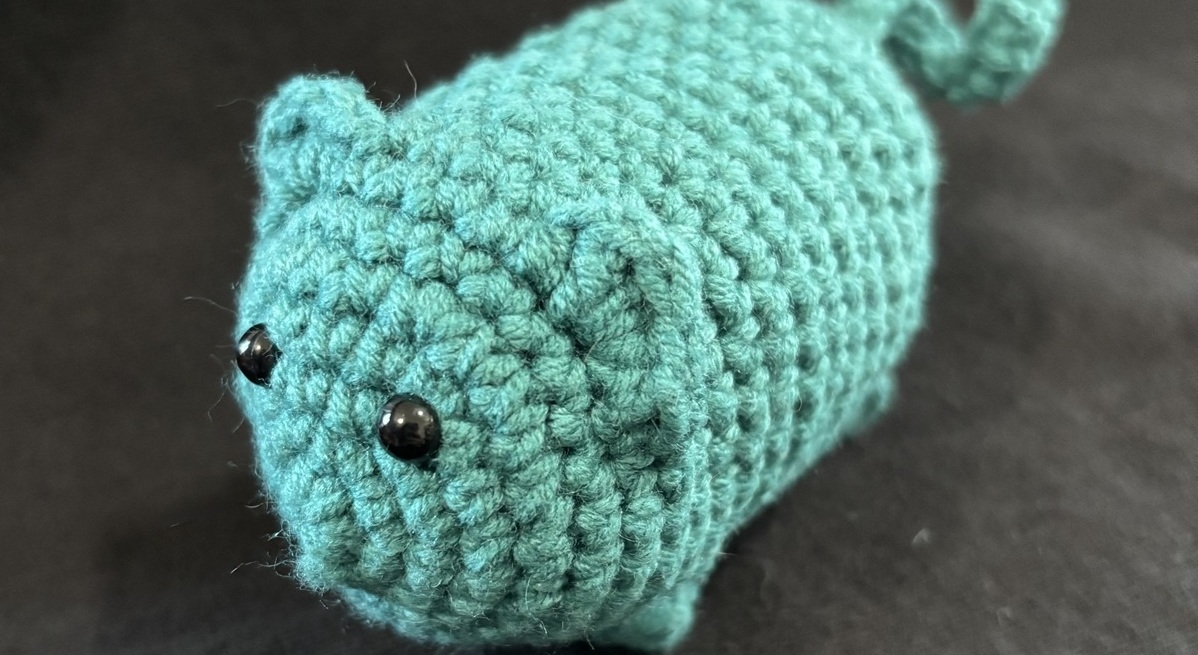
Conference Creatures has made us aware of other creators and ideas that extend the possibilities of material artifacts and digital networks for establishing relationalities, maintaining connections, and strengthening communities. Though Conference Creatures' focus on professional academic spaces, circulation through social media, and crafting reflects our own interests, experiences, and conversations, we feel that the convergence of our approaches with other projects and ideas are now an important part of the Conference Creatures story. Drawing attention toward other projects that resonate with Conference Creatures, we hope, will encourage others to experiment with the ways our professional lives, personal interests, and scholarly practices create possibilities for our research, work, and play.
After we established the initial idea of Conference Creatures—crochet and knitted plushes to give away at field conferences—we quickly envisioned our project to be longitudinal with no predefined end; however, that assumed we would have a project to sustain. Our intention to get other scholars in rhetoric and writing studies involved and engaged with Conference Creatures centers around conference attendees finding joy in their creatures. To increase the potential of the project gaining interest and of our chances to know if others found joy in their creatures, we arrived at the idea of using social media to circulate, display, and document our project. Ideally, conference goers would bring their creatures to other conferences with them to hopefully build connections in their professional worlds, and the creatures' travels could be documented on social media.
Apart from the traveling creature aspect, Conference Creatures recalls Dale Hubert's The Flat Stanley Project, which builds on Jeff Brown's (1964) story, Flat Stanley. Hubert's project relies on material artifacts (paper Flat Stanley), circulation of the artifacts, and documentation (journal and photographs or other souvenirs), which facilitate reading, writing, and social literacy activities for young students. Conference Creatures' similar dissemination mirrors the Flat Stanley project, but with a focus on professional social literacies and facilitating connections.
As we started to seriously consider pursuing Conference Creatures, we became aware of other projects that Conference Creatures broadly resembles. Margaret Price's @Bunny_nugget and Sarah Tinker Perrault's "The Daily Dev" both use creatures of a sort to communicate about travel, experiences, and ideas about the world. These entities have ongoing appearances on social media and invite social media users to experience along with the creatures.
Formal or professional spaces, too, hold opportunity for creating and exchanging artifacts with one another while using the space to disrupt the neoliberal logics perpetuated by academic norms. Kaela Jubas's and Jackie Siedel's (2013) ethnographic knitting circle describes two academics who used their knitting circle to host conversations about capitalism and exploitation in academia. Their relational praxis of creating and conversing (known as "stitch 'n bitch" in many knitting and fiber arts communities) helped them come to understand knitting as a metaphor for work within capitalism.
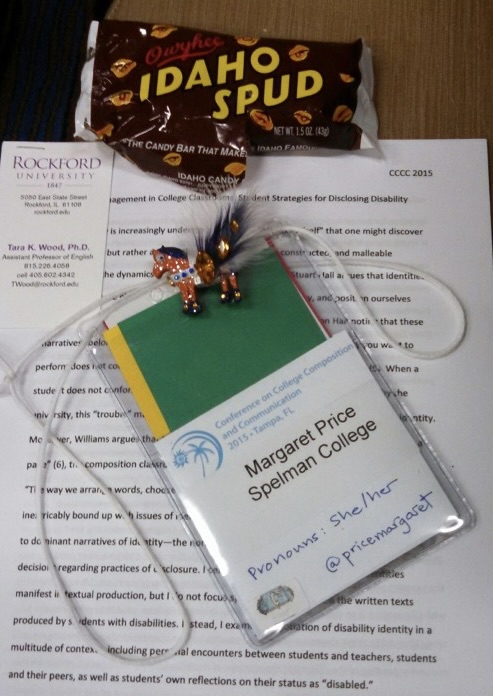
It wasn't until we began talking to others about Conference Creatures that we were introduced to the lore of Sparkleponies and C's the Day (deWinter & Vie, 2015). Like Conference Creatures, Sparkleponies were artifacts embedded into field conference spaces in writing, rhetoric, and literacy studies, though C's the Day was far more elaborate by inviting participants to go on quests. Though Conference Creatures is not structured around gameplay, other similarities, such as our targeted venue, professional exigence, use of physical artifacts, and attention to networking, act as basting stitches that align and superficially hold the two projects together. However, once we began distributing Conference Creatures at conferences, we realized the extent to which peoples' Sparkleponies experiences continue to impact scholars in our field.
Our practice of distributing Conference Creatures often prompts conversations about Jennifer deWinter and Stephanie Vie's (2015) project. We truly appreciate when folks rummage around in their brain storage and recommend deWinter and Vie's article; that "rummaging" is a gift. In addition, some creature-gifting interactions prompt individuals to recall affective experiences linked to Sparkleponies. Descriptions of their own Sparkleponies, tales of acquiring their Sparkleponies, anecdotes about the conference the year they got their Sparkleponies, attempts to remember the host city, and where they currently store their Sparkleponies have all been subjects of fond recollection by folks we've interacted with through Conference Creatures. Though Conference Creatures was not designed using Sparkleponies or C's the Day as a model, the phenomenon of our project stimulating positive Sparkleponies memories becomes a more significant and enduring running stitch. As creature recipients reminisce, they enact a sense of connection, both between the speaker and anyone listening, but also between Sparkleponies and Conference Creatures. The affective thread of Sparkleponies memories and Conference Creatures in the present holds the projects together across time, and our own experiences in these moments view the affective transmission of others' joy into us as additional acts of reciprocity.