On Kairos's 30th Anniversary
Christopher Andrews and Erin K. Bahl, Co-Editors
- Introduction
- Kairos's Masthead: A Staff Chronology
- Logging Off with Cheryl Ball
- 30th Anniversary CoverWeb
30th Anniversary CoverWeb
To commemorate the journal's 30-year anniversary, we invited the Kairos community to contribute brief responses (3 minutes, 3 images, or 300 words) reflecting on what Kairos means to them and the field of digital rhetoric. Their responses covered a wide range, but we've loosely grouped them here into common themes of technology, innovation, community, scholarship, and mentorship.
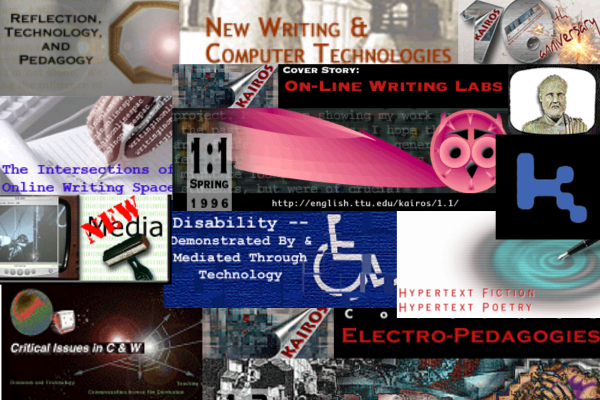
We've presented these statements in a webtext shell that pays homage to our original CoverWeb design as of Fall 2007, prior to the re-design launch in Fall 2008.
We've provided links to many of our contributors' publications at the end of their entries, and hope you enjoy a trip down memory lane or find something new and interesting that you hadn't seen before.
Technology
Kairos is a place for creativity, exploration, and experimentation. It's a daring place because you have to code your own stuff, which can be daunting and frustrating, but it forces you to grow in the way you think and perform your ideas on the digital page (whatever that is to you). It also invites you to collaborate with others.
The digital can be broken down into different tasks that require very distinct skills in ways that alphabetic can't always be broken down. Kairos then is a place that's tailor-made for working with others, for learning from your collaborators and getting a kick out of venturing into the digital unknown alongside them.
I look forward to seeing how this journal grows as the digital continues to expand and evolve and (often) terrify us. Can we take the digital back? Turn it into something beautiful and full of hope and possibility? I think so. At least partially. I can't wait to see how Kairos plays its role in that journey!
Kairos published my first co-authored webtext as part of my PhD in 2019 and I will be forever grateful for this! The reviewer feedback when preparing the webtext was super helpful for me as a first timer, and the overall experience grew me as a researcher in the early days of my study. I was also incredibly fortunate to have Cheryl Ball as a course convenor while studying at AHO in Oslo, and of course the amazing and dedicated supervision of Andrew Morrison throughout. I loved the opportunity that Kairos presented for me to explore an alternative text and platform that was more in tune with the content and context of my study, which was about exploring expansive spaces for design learning. Through a spatial and journey-based interface, the webtext embodies a multimodal, qualitative inquiry into ways to support dynamic learning for undergraduate design students as they explore their emergent roles as critically engaged and resilient designers transitioning toward sustainable design practice. As a design educator I have drawn on this experience in numerous ways, in my teaching, ongoing research and course building at Cape Peninsula University of technology where I'm based.
A Tribute to Will Hochman
(2015). Great debating: Combining ancient and contemporary methods of peer critique. Kairos 19(2).
Innovation
Kairos is a pioneering online rhetoric and composition publication, and it has remained robust and vital throughout its existence. Its focus on webtexts has been crucial and not without significant challenges, as earlier iterations of the public web offered authors considerable liberty but limited durability and consistency. Kairos's ongoing work to preserve rhetoric and composition scholarship's digital history while embracing contemporary standardization is necessary and commendable.
From its inception, Kairos has activated graduate student contributions and cultivated an ethos distinct from individual editorial staff, which has sustained it while other innovative disciplinary publications have slipped into quiescence. As the included webtext suggests, Kairos has been geographically and conceptually distributed as technology shifted from being a facet of rhetoric and composition to its paradigmatic grounding. Kairos presaged the current disciplinary moment and continues to shape its development.
(2012). A geographical History of online rhetoric and composition journals. Kairos 16(3).
Kairos is a phenomenon; it is interdisciplinary and transdisciplinary in a way that most of rhetoric and composition studies sometimes isn't, in a way that is perhaps more indicative of the broader field of digital humanities than of either digital rhetorics or writing studies. Kairos is a place of experimentation and play. In "You Say You Want a Revolution? Hypertext and the Laws of Media," my grand-mentor Stuart Moulthrop (1991) discussed hypertext software like StorySpace through the lens of Marshall McLuhan's 1975 tetrad of media effects. Multhrop asked of hypertext: "What does it enhance or intensify? What does it render obsolete or displace? What does it retrieve that was previously obsolete? What does it produce or become when taken to its limit?" (p.691). While much has changed since 1991 and certainly since McLuhan's context in 1975, my questions for situating texts & technology as a discipline remain similar.
I, of course, have never met Dr. Multhrop; the closest I have come to him or his work is my copy of The New Media Reader, and yet, the transmission of asking these sorts of questions about emerging technologies came to me by way of his student, my mentor, Dr. Anastasia Salter. As one example of them asking similar questions in markedly different work, in a 2019 visual essay called "Being Mii for Hyperrhiz: New Media Cultures," Dr. Salter (2019) asked similar questions of VR technology: "What are you going to use VR for? To make? To escape? How much do you think about the software you use? Who controls it? What does it change?" Whether the technology is television or radio, StorySpace or Twine, Miitomo, or my work regarding indigenous representation in Pokemon or my recent Kairos piece about syllabus accommodation statements, the questions endure, and the transdisciplinary genealogy continues.
(2025). One disabled student's dream syllabus statement. Kairos 29(2).
Kairos is the first journal to publish experimental webtexts and reveal the rigor involved in making such collections. So much of my experience with this journal is bound up with fond memories of working with Cheryl Ball and Doug Eyman. They offered invaluable feedback on my work and eventually encouraged me to be part of the editorial board. As an up-and-coming scholar, seeing new work take shape and listen in as senior colleagues weighed in on suggestions for various projects proved fascinating. Given that many of my conference experiences centered around those who were also publishing with Kairos, it makes this journal feel like homebase. My publishing record with Kairos isn't super extensive, but it's always the first journal I consider when drafting a new project for myself or providing feedback for a colleague. How can a rhetorical scholar deny the appeal of a journal whose very name translates as "critical moment"? It's a journal open to more than just words-in-a-row; instead, Kairos celebrated things like multimodal video performance. Overall, it's a journal that always delivers on what new questions might be asked and new solutions might be framed. It's a journal that is hard to deny, especially when sharing its content is as easy as copying and pasting a link. There's an immediacy to its scholarship that anyone growing up, as I did, in an age before the Internet, can't help but feel the field was always moving towards. That is, Kairos felt like the future. And now that the future is somewhat here, it's a great archive of how we've got to now.
(2010). Diogenes, Dogfaced Soldiers, and Deployment Music Videos. Kairos 14(3).
I don't know of another journal that has embraced the complexity of multimodal scholarship on every level, from reading to peer review, as extensively as Kairos has over its 30-year history. Kairos continues to foster a vibrant intellectual space where scholars can experiment with new forms of scholarship and review. And indeed, perhaps that permission to experiment is the most important thing Kairos has done, as it encourages creative scholarly forms that make use of and interrogate a wide array of digital affordances. Kairos pushes the boundaries of what scholarship can be.
(2011). Becoming Book-Like: Bob Stein and The Future of the Book. Kairos 15(2).
Community
I am so thrilled to see Kairos entering its 30th year! Kairos is much more than just a publication—it broke trail as one of the first online publications in our field. Along the way, it has continued to lead, providing open-access content to its readers, adopting more inclusive review practices, and even navigating the ever-roiling terrain of generative AI in the online publishing world. The publication started, and remains today, in the vanguard of research and scholarship on topics exploring the intersection of rhetoric, technology, and pedagogy. Its longevity is a testament not only to its innovation, but to its relevance and responsiveness to the evolving needs of our scholarly community.
More than even that, though, Kairos is itself a community. And a pretty cool community at that. It is a welcoming place that mentors younger scholars, fosters collaboration, and celebrates experimentation. The people here you know immediately just by the mention of their first names alone: Doug, Cheryl, Mick (RIP), Michael, Erin, among others. These names represent not just leaders, but generous peers and colleagues, working shoulder-to-shoulder, lifting others up while advancing the conversations that shape our field.
(2017). A distant view of English Journal, 1912–2012. Kairos 22(2).
Collaboration. As a neurodivergent academic, I've found it challenging to navigate social and professional situations, and as a result I haven't experienced many collaborative opportunities for research. I am endlessly appreciative that I have gotten to experience positive, productive collaboration during my time on the Kairos staff.
I actually didn't get hired the first time I applied to Kairos. I was a newly-minted PhD, though lacking in the type of design and copyediting skills needed. Cheryl sent me a very kind message to let me know, and while I don't remember what she said, it encouraged me to learn more and try again to apply the next time they were hiring. This time I did get hired, and have been at Kairos since 2011, starting as an assistant editor, then section editor for Reviews, then Topoi/Praxis/PraxisWiki, and now as managing editor. During this time I've gotten a chance to collaborate with so many of my colleagues, as we often double or triple-up on editors for each section to balance the workload.
Once we started having monthly Tier 1 staff meetings (for initial review of new submissions, as well as check-ins for each section), that collaborative process has been an invaluable experience. It's encouraging to work with others that have the same interests, the same values, and equally want this journal to succeed. It's refreshing to be part of an academic publication that is fully independent, existing outside of patriarchal, capitalist institutional structures, in a position that can speak truth to power. (Or at least as far outside of capitalist structures as we can... we still have to pay our server costs. BTW, contribute to our Patreon!) In any case, I'm thankful that Kairos is celebrating 30 years, and I know our continued success is due to our fantastic collaboration.
Kairos has always meant community to me—not only a supportive and positive-force culture of peer review but also a collective of practitioners pushing publishing and scholarly communication in timely and necessary directions across media.
(2008). Geolocating Compositional Strategies at the Virtual University. Kairos 12(2).
Scholarship
Thirteen years ago I was a graduate student taking my master's degree in literature. At the time, I wasn't aware that there was such a thing as a field of rhetoric and composition. My second year in the program was revealing, and it happened to be multimodal texts that made me aware of the field. I was in my first semester of teaching a first-year writing course and a student in a colleague's class submitted a multimodal video essay, something I had not yet encountered. The student's assignment was intended to be an icebreaker that told something about them and their family. They were allowed to use any type of mode they wanted, from written, to audio, to webtext, to video. To my knowledge, this was the only student who decided to write a non-alphabetic essay.
When I mentioned to this colleague both my admiration and surprise at this mode of essay, I was informed that not only had English studies been warming up to multimodality since the turn of the century, but entire programs of writing studies existed that harbored such conversations. I also learned that entire journals such as Kairos were havens of this discourse. When I began my doctoral study about a year later in rhetoric and composition, I had the opportunity to further research and dig into the extensive archive of Kairos, which allowed me to become more conversant with this aspect of rhetorical studies. I was impressed that Kairos hosted webtext editions, matching both the form and the subject matter of the scholarship. And as other young scholars came to discover, I also realized that Kairos also provided an extensive professional avenue to connect with other scholars whose work was published on its site. Here's to 30 years of Kairos, and at least another 30.
From its outset Kairos was—and continues to be—a crucial pioneering space in the field for sharing research and classroom practice around digital rhetoric. When I was a graduate student over 20 years ago teaching a new course on multimodal rhetorics, I turned often to the journal for inspiration, and through the years, articles in Kairos have helped me negotiate and think about emerging developments in our field and in our classrooms. So many of us would not have multimodal projects without there being Kairos. And in all the years I've served on the Kairos review board I find the process of collaborative, dialogic reviewing so in the spirit of the computers and writing community. I learn with every article I read and with every issue published. I am so grateful for the creative, impactful scholarship of all contributors and of the extensive service and contributions of the journal's leadership teams through the years. Thank you all, and here's to 30 more years!
Mentorship
There are two interrelated things about Kairos that stand out in my mind. One is the editorial process, which is designed to be inviting, supportive, and process-based. Unlike almost any journal I can think of, Kairos supports and mentors their contributors from early on, guiding and encouraging them forward. It's a process that supports inclusion and equity. The other thing about Kairos is that it supports multimodal research. I'd call it one of its core missions. For interdisciplinary researchers whose intellectual journey does not begin (or willingly end) in a discipline-bounded flatland of two-dimensional text on a white screen or page—text that might as well be strung out in one long, straight line... the kind of line that Mina Shaughnessy once described as a tight rope along which one teeters—Kairos is a home away from home. Kairos supports and celebrates arguments that need to be developed in the same multimodal framework in which they were imagined. It's been nearly 15 years since my webtext was published in Kairos. Kairos was the only journal in our fields in which I could have published the kind of Flash ActionScript-based project that I'd designed. The support and encouragement throughout the editorial process was deeply appreciated. It would be difficult for me to imagine the fields of rhetoric and composition without Kairos.
(2010). Typographia: A Hybrid, Alphabetic Exploration of Raleigh, NC. Kairos 14(2).
Kairosnews (2002–2011)
In late 2001, I decided to apply for a news editor position at Kairos after seeing a call for applications on the TechRhet listserv. I was an MA student at University of Tennessee, and I recognized this position as a good professional development opportunity. Soon after I applied, folks from the journal contacted me and offered me the role along with Charlie Lowe, then a graduate student at Florida State University. After some emailing, Charlie and I decided to speak on the phone, and we discussed the idea he had pitched, which was to make the news section "a daily news site," as Charlie put it, "like Slashdot." The idea sounded fine to me, so we proceeded, and the Kairos team met up in person at what was my first CCCC [Conference on College Composition and Communication], in 2002. It was wonderful for me, as someone who hadn't started a PhD program yet, to get to know people like Anthony Atkins, Colleen Reilly, Doug Eyman, Cheryl Ball, and others who were a little further down the line than I was. Kairosnews ended up being one of the first group blogs run by and for computers and writing teachers and scholars, and it was a great generative experience; my career would not have been the same if I hadn't been part of Kairos in that formative stage. From Kairosnews came a lot of the work in rhetoric and composition studies about Creative Commons licensing, open-source software, and other emerging technologies. I am so grateful to everyone at Kairos from that time all the way to now, and my colleagues with Kairosnews: Charlie Lowe, Matt Barton, Jeff Rice, David Blakesley, and many more.
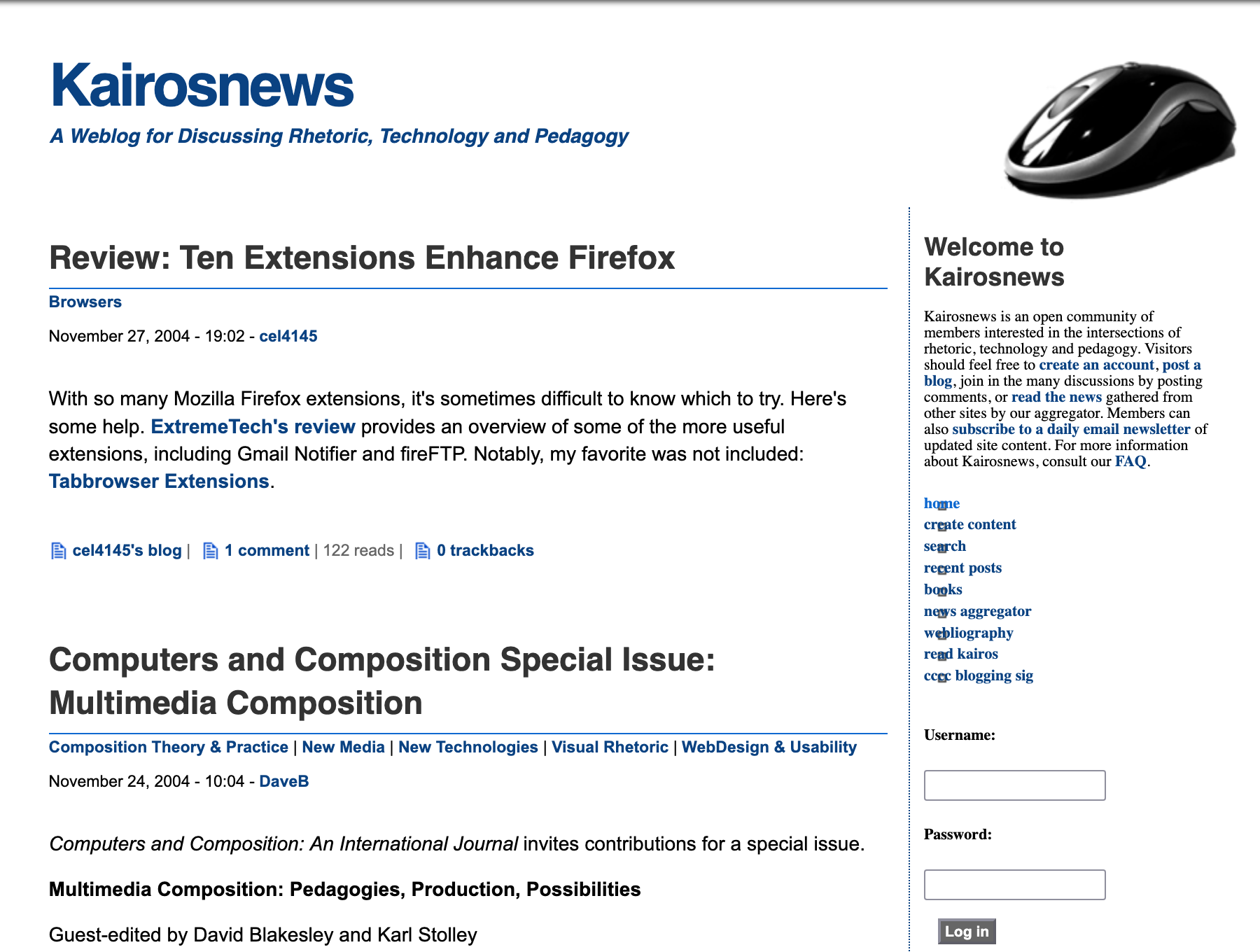
Image description: a screenshot of the Kairosnews website, with the title Kairosnews at the top in a dark blue sans serif font. Under it, the words: "A Weblog for Discussing Rhetoric, Technology, and Pedagogy." On the right side of the screenshot is a photo of a black computer mouse. The top post, dated November 27, 2004, is by Charlie Lowe and is titled "Review: Ten Extensions Enhance Firefox," and the post under it by David Blakesley, dated November 24, 2004, is a call for proposals with the title "Computers and Composition Special Issue: Multimedia Composition."
How could I possibly sum up what Kairos means to me in 300 words? I know when some people think about the digital rhetoric or computers and writing community, they think of C&W [Computers & Writing] meetings or one of our beloved luminaries in the field. I always think first of Kairos. I realize just as I write this that I've been with Kairos longer than any of my other academic gigs. Like many of us on staff, I inched my way through editorial ranks over the years—assistant editor, associate editor, section editor, managing editor, and now co-editor. When I started with the journal in 2011, I knew just enough about HTML and CSS to fake my way through stage two edits. A few years later, I'd be taking pride in working with Tim [Amidon] and Elkie [Burnside] and a crew of others to hand-code a whole webtext, top to bottom. In charging, unafraid, through nasty WordPress edits. In the intervening years, I probably spent more time on Stack Overflow or MDN Web Docs trying to figure out arcane bits of CSS markup than I did anything else. I think that's a big piece of Kairos to me: I've learned much more working with these people and on these kinds of problems than I ever expected to. Not just learning about web design and markup editing, but learning how to be a good collaborator; learning how to do distributed volunteer work; learning how to help develop authors; learning when to take the lead or when to shut up and listen; learning how to make decisions and problem-solve in inclusive and thoughtful ways. I've learned from and digitally hung out with dozens of great people over the years, and watched the journal shift and iterate through incessant digital communications technology changes. Kairos... IS digital rhetoric to me.
(2015). Composing MOOCs: Conversations about writing in massive open online courses.Kairos 20(1).
Kairos is a professionalizing space and invaluable disciplinary community space. It's truly rare to say "I answered an email, and it changed my life," but that's what happened. I was first introduced to Kairos as a graduate student in a multimodal composing class, which became the basis of my first contribution to the journal—as an author.
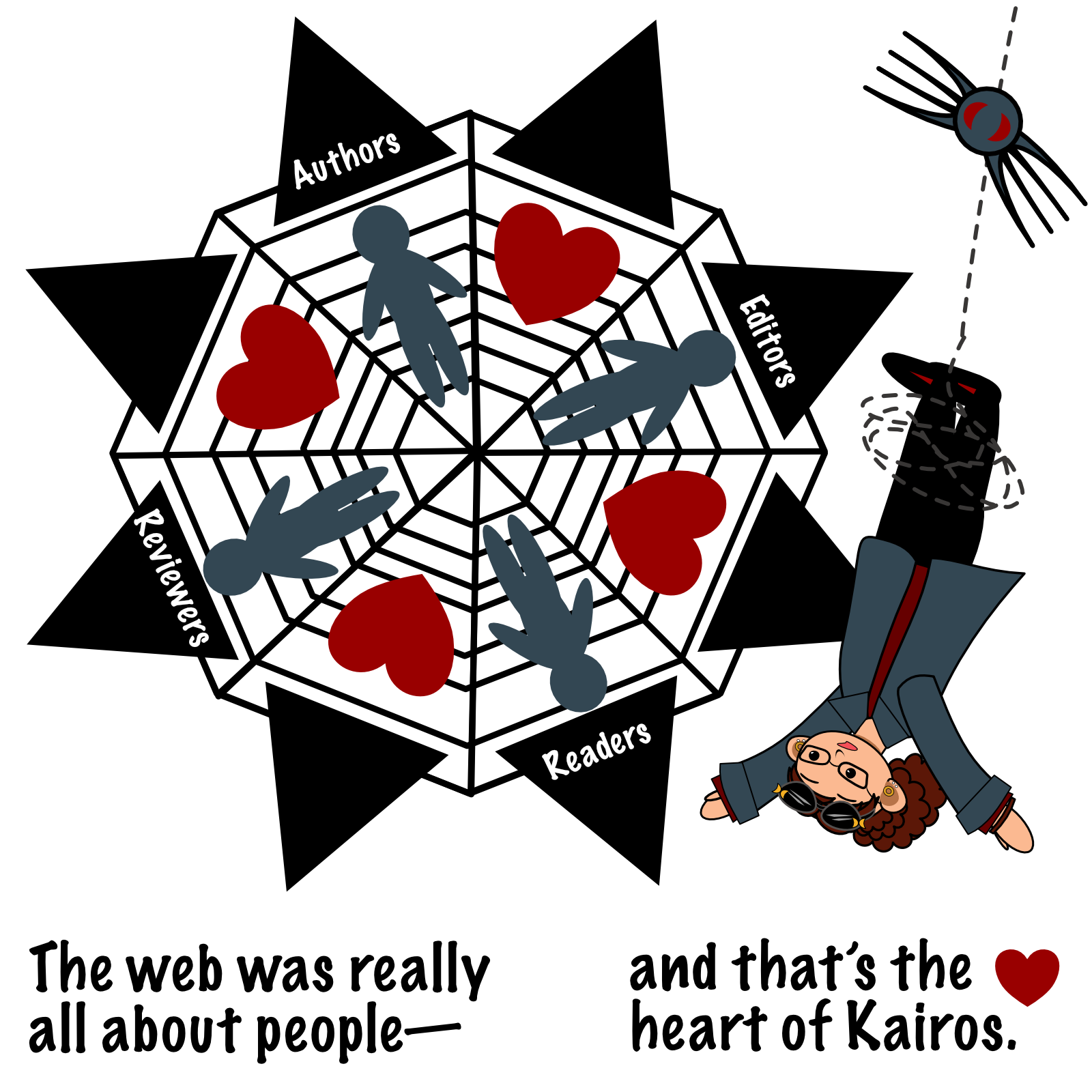
Early in my doctoral program journey, I saw an email ad for an assistant editor position at the journal. I was seeking spaces to contribute in the field. I also had experience and am a passionate copy editor. I applied. The next step involved a "multi-part copy-editing quiz," that quickly taught me the rigorous expectations of what Kairos assistant editors do. The bar at Kairos is high—editors are challenged and pushed in rewarding ways to aid in publishing exceptional scholarship. More importantly, the kind people behind the scenes understand and show us that the humans are the heart of Kairos are what help it thrive.
Kairos's 30th anniversary coincides with my 10th with the journal, serving in multiple capacities across the journal over the years as I moved in my career from doctoral student to tenured faculty to, today, associate graduate dean:
- 2016–2018: Assistant Editor
- 2018–2020: Associate Editor
- 2020–2025: Reviews Section Co-Editor
- 2025–present: Topoi/Praxis/Praxis Wiki Sections Co-Editor
Without a doubt, this role has been the most meaningful service position I've had in our field. The friendships and scholarly community alongside years of getting to engage and nerd about super cool scholarship are tough to beat. Congratulations, Kairos!
PS: Cheryl, I hope the em-dashes, en-dashes, and hyphens throughout are correct.