On Kairos's 30th Anniversary
Christopher Andrews and Erin K. Bahl, Co-Editors
- Introduction
- Kairos's Masthead: A Staff Chronology
- Logging Off with Cheryl Ball
- 30th Anniversary CoverWeb
Closing Reflections from Cheryl Ball
This is my love letter to the field. And love, as we may think, is complicated.
I recorded the following monologue in my car, stream-of-consciousness-style, upon leaving the Computers & Writing Conference in Athens, GA, on May 18, 2025. The air quality and my allergies were bad that day, so please forgive the occasional sneeze, cough, and sniffling. I promise I was not sick! Please also forgive the car noises that Erin Kathleen Bahl has done a remarkable job of editing out, and the one under-my-breath expletive when fog stopped traffic as I drove through the North Carolina mountains.
My goal in recording was to capture my feelings on knowing this would be the last C&W I'd attend, having already announced I was stepping down from Kairos after 25 years. This storytelling journey sparked—as it often does with me—interwoven backstories of figuring out who I was in digital writing studies, personal revelations during past C&W conferences, and getting to spend decades with beloved Kairos. It cannot possibly sum up how I feel about stepping down from the journal, though I make some attempts at explaining why I was ready.
The new Kairos editors kindly agreed to include this text in the 30th anniversary issue, which I am incredibly grateful for. I am responsible for any of the hot takes herein, as they represent my perspective during those specific moments along my ever-learning journey. I had planned to turn this audio file into a blog post, but upon re-listening to the audio, I believed it would be more fulfilling to hear it coming from me instead of reading it, for those for whom that is possible. (Sincere apologies to Beyoncé for my off-key singing of one of her beautiful songs.) For those who need to read the transcript, I have attempted to edit it in a way that indicates my pauses, my excitement, my hesitations, and my laughter. Thank you all for letting me be a part of your lives for so long! Enjoy.
You can listen to the interview in full, or scroll to different chapters, viewing transcripts and downloading files by selecting the gray background underneath each audio controller. As mentioned, this is an off-the-cuff, no-script recording that I made in the car, so there are some long pauses as I thought about what to say next, and I’m speaking more slowly than usual. If you want to listen as I was thinking this out loud, enjoy as-is. If you want to hear me get to the point but still want my laughter present, I recommend downloading the full version and playing it on 2x speed.
Full Reflection (1:43:57)
Full Transcript (PDF)
Download Full Reflection (MP3)
Part 1: Introduction (9:12)
Download Part 1: Introduction (MP3)
It's May 18, 2025, and I'm leaving Computers & Writing in Athens, Georgia, on my way to Maine. The weather turned cloudy this morning, and it's a bit cooler and just a titch of rain. As I headed out of Athens, I know it's my last Computers & Writing conference, and it took me a while to figure out what this feeling in my body was, and it's an airiness, a lightness, grateful that I don't need to return to this conference again.
I came into it with trepidation, as I have the last several years, where my excitement to engage and meet new people and new graduate students and early career faculty has turned a little bit to dread as I felt like I was giving away too much energy in a lot of these instances. And there were always some players who took up more energy than I had to give, but I had bad boundaries, and had to develop those over the years. And so they were exhausting to me. I let them exhaust me in a way that I was prepared to not do this year.
I was also walking in this year knowing that I had very few good friends who were going to be at the conference. The senior guard, the founders of the field have all retired. The second generation of computers and writing scholars never came to the conferences. They were a sleeper generation. I wonder, maybe because they're all fairly introverted, and perhaps the senior generation had to be so extroverted in order to get the work done and turned into a discipline. So now it's the third and the fourth generations who are the figureheads. It basically feels like people like me and Doug [Eyman] and Kristin [Arola], who wasn't there this year, but who most people know, and a few others, are the senior folk. The Charles Moran award is going to younger and younger people in the field, because as the senior folks get older, they've already won the awards, or they're stepping out of academia like myself.
I knew it was time to start thinking about stepping out of the field the year after I left the faculty. At the time, I was going to both Computers & Writing and Library Publishing Forum (LPF) regularly. As more and more people knew me at LPF, it seemed like fewer and fewer people knew me at Computers & Writing. This is good because it means it's a healthy discipline that has more newer and newer graduate students coming into the fold. And it means my work is perhaps being read less and less, and that's okay. My research covers a moment in time, and while I once thought that it was something that I wanted to be known for, and I have been, it's not something I want to be eulogized for.
The moment hit me probably strongest when the conference was rerouted in 2019 to Michigan State, and I went up to the registration table on the first day to get my badge, and at every other Computers & Writing for the last 20-some years, people have known immediately who I am and handed me my badge without asking. I mean, that's a lovely feeling, admittedly, but I rested on that ego and used it to my advantage and to the field's advantage, I feel like, for a long time.
But at that Computers & Writing, the graduate student working the table said, "Who are you?" And I laughed, and I said, "I'm Cheryl Ball," and they had zero recognition of what that might mean in the discipline, the foundational research that I'd published in new media and digital scholarship and multimodal composition, the leading journal in the field that I edit, the place of leadership among the discipline and especially at Computers & Writing. None of that registered with this student. And at first I was like, "Huh?" And then I was like, "Yeah. For some reason, that feels right." I didn't know how to deal with that at the time, except just to tuck that feeling away and to start asking myself, "Why are you still here, Cheryl? Why are you still at Computers & Writing?"
Part 2: Computers & Writing 2022 (3:57)
Download Part 2: Computers & Writing 2022 (MP3)
In 2020 and 2021, the conference was canceled, of course, because of the pandemic, and we went back to East Carolina [University] in 2022 where the mood was for me, at least, felt slightly somber. And the conference felt small and cozy, which wasn't surprising, given that many of us were still in a COVID-consciousness phase, so we were masking. Some of us were masking still in group spaces. I was for the most part. I hadn't yet gotten COVID, though I did shortly after, at my first Library Publishing conference back after the pandemic. Yet it was still good to see close friends, or just long-time friends, even if they're not close. It was great to see Will Banks and Michelle Eble and the folks at Greenville who were running the conference at ECU. It was great to meet some folks in person who I hadn't yet met, like Antonio Byrd, McKinley Green, Wilfredo Flores, folks who are doing amazing research in the field and who I was grateful enough agreed to serve on the editorial board for Kairos. They've made wonderful additions.
That was the year where instead of karaoke or bowling, we went axe throwing, though, and the noise was so loud that my soul was like, nope, and I wore my headphones through most of the event, even though Kairos was sponsoring it. Instead I read, I sat in a quiet corner and read tarot for people. And that was a good time, especially when we got to go next door, and I was able to read some spreads for some longtime friends. But I didn't yet know that that was towards the end of my time at C&W.
Part 3: Computers & Writing 2023 (8:42)
Download Part 3: Computers & Writing 2023 (MP3)
It took a whole 'nother year when I went to C&W in June of 2023 at University of California, Davis. I got to fly with Kristin [Arola], because she was keynoting, and Jenny [Sheppard] was there, and we were all at the same hotel, and we had a blast. [They are some of my oldest friends in the field, grad school buddies, and co-authors on Writer/Designer.] But what I remember most from that conference, other than Kristin's keynote, which, frankly, may have been the only session that I attended while I was there, or sort of three things:
I was anxious to go to the opening reception. I but I went with Kristin, and I think Jenny was there too at that point, and I made sure to go around to every single table and say hello to every single person, I feel like, who was there. It was a big, bigger conference [than ECU]. There were probably 200 people, maybe 150 to 200 people at the opening reception in a lovely outdoor space on the UC Davis campus. And that was the year people started asking me, "Oh, how are you?" And lots of people who hadn't been at the ECU conference asked about like, coming through the pandemic, and you know, how the last year had been, and I just got so tired of the pert answers. I wasn't interested in the small talk. And I realized this almost immediately, so I began asking people, I stopped them when they asked me, "How are you doing?" or "How are things?" or "How are you?" And I said, "I don't want to answer that question anymore, because it feels very flat." So instead, I want to ask questions of people that help us know each other better.
Questions like, "What's the biggest thing you've learned about yourself in the last year? What's the thing you've had the most fun doing in the last year? What was the biggest challenge you faced in your personal life in the last year?" These were deep questions, and I didn't know what to expect and how people might respond, but I was grateful that, to a one, folks said, "Oh, I appreciate you asking a question that's more meaty." And they were happy to answer my more complicated, deeper questions, even when it meant revealing something about themselves and being more open and vulnerable than they would normally. And these were people I didn't necessarily know. They might have known me or known of me, right, from the field, because there was a little bit more recognition that year, but I didn't care. Like, even the tinge of like, "Oh, that student at MSU didn't know me, what am I doing with my life?!" that had happened four years before was now completely gone. I didn't give a shit anymore whether they knew me. But what people kept saying over and over to me again was, "We're so grateful you're here, Cheryl, we're so thankful that you're here to bring us together and to engage the community. And what would this conference be like without you?!"
Well, those compliments weighed heavy on me, because I was battling the tensions between my ego and my releasing of that. People were happy in the way that I brought people together at the conference, and in a way, held the field together. But I didn't want to do that anymore, or at least, like, that was the moment of clarity for me when I left the reception and walked back to the hotel with Kristin [Arola], who commented that I seemed exhausted, but I was kind to everyone, and she noted that. And so she asked me, as only a best friend can, "Why are you here?!"
And I chuckled and said, "You know, I don't know why I'm here. I don't enjoy this anymore. I don't want to go to any of the sessions..." (Except for her keynote, which was amazing.)
Part 4: Changing Energies (8:10)
Download Part 4: Changing Energies (MP3)
The second thing that was happening was that I had a new girlfriend, and so we kept talking, and Kristin [Arola] would witness me talking with her and Jenny [Sheppard] too sometimes, and they thought it was very cute and sweet, but they also had reservations, and soon so did I. But the distraction of talking to her during the conference also helped alleviate any guilt that I had about feeling like I didn't need to be at C&W anymore.
The third thing that happened during the conference was that my body was radically shouting at me to stop being there. I remember that I drew the High Priestess [tarot card], I believe it was, on the day of the reception, and I certainly channeled that energy. Plus it was late June, and it turns out that the conference fell over the Summer Solstice. So I believe, in a series of days—and I will have to go back and check my tarot pulls—I pulled the High Priestess, the Hierophant, and the Empress; energies that absolutely connected to what was happening around me at the conference, and my engagement, I should say, with the conference. The way that I chose to engage with the conference, which was a bit distant, a bit from a distance from an energetic level, I mean, I want to say parsimoniously, but I don't actually think that that's correct. I think it's more as a spiritual guide like the Hierophant, the interpreter of arcane knowledge, but they're not getting in the mix. They're just they're the wise figurehead who has been through the trenches and then stands at a distance to provide guidance, as requested.
My body took the Full Moon and the Summer Solstice and ran with it, and I had one of the heaviest periods I have ever had since I was a kid. My cramps were out of control. I spent most of the week rubbing my belly and probably doing shots of gin, laying in bed, bleeding all over the fucking place, and realizing that my body was telling me that it was time to let this flow of energy that I have kept as part of my system for 25 years complete its cycle.
Six weeks later, during a senior team meeting with the Kairos editors, I remember thinking at the beginning of the meeting, "Oh, it's August 8, 2023, it's the 8/8 Lion's Gate portal." The Lion's Gate is a portal of energetic ascension, of awakening, of being able to see things and act on them in a way that you perhaps hadn't been able to before. If you do the spiritual work, and you trust in the Universe to present you what it is that you are trying to manifest, what you believe in, what your values are, then a new level of understanding will be available to you.
So in that meeting, we started off in the regular way, talking about getting an update from production, from Michael [Faris], and then going into our regular business with me and Doug [Eyman]. And as we got into a certain part of the conversation, the issue of AI came up, and Doug is very invested in researching how AI impacts Writing Studies and the publishing process, and Michael is also very invested in it. They're both very well researched, and still have a curiosity about research that is quite strong, whereas mine had begun to fade several years earlier, truly at the beginning of the pandemic, mine started to fade, and probably, if I'm honest, much earlier than that. And I knew that that was a problem, not a problem for me, but it was a problem for the journal.
Part 5: Editorial Lifespan (11:46)
Download Part 5: Editorial Lifespan (MP3)
Back in 2008 I had been lead editor of Kairos for only two years, at that point. I'd been on the staff for only seven years at that point, but I'd worked my way up, and between 2008 and 2012, I was working on a book with Debra Journet and Ryan Trauman. It was the Watson Conference proceedings for the 2008 conference, and I remember a couple of points during that time when Cindy Selfe and Gail Hawisher came to me and said, "Cheryl, why don't you come work for CCDP [Computers & Composition Digital Press] as a production editor? We could use your expertise." This was probably in 2012 because I think, earlier than that, I had... it was a different story.
So they had approached me once or twice, and they hadn't phrased it as, "Hey, come join our team. This will be great." Instead, they approached it as, "Aren't you done with Kairos yet? Why don't you come work for CCDP?" (While work, of course, is volunteering.) And I was a bit taken aback, because, yes, I had become one of the faces of Kairos, and I had done a lot of good work with the journal by that point already, but I was kind of mystified by their assumption that I was quote, unquote done with Kairos. And I said, "No, no. I am really enjoying my work with Kairos, and I feel like I have a lot more to contribute to that venue. So I'm not done with it yet."
But those conversations got me thinking, and I did go on to do a lot more with Kairos, you know, creating all of the training documentation and getting the training wiki instantiated, writing two different grants, big grants that would go on to help Kairos try to think about the publication platforms that might assist it, and other types of journals who want to work with digital multimedia scholarship. So I had a lot of growth still left with the journal when they asked this question, and I was also like, "Why would I step down from being the lead editor to being a production editor at a press?" Like, it's a lot more work for a lot less recognition, frankly. At least, so I thought at the time, and the way that they were presenting it, right? Because they were still years away from retirement at that point, so they would continue to be the founding lead editors.
But the question did make me start thinking, okay, at that point, if I've been at Kairos for, you know, 10 plus years, what would my end point look like, you know? Cindy and Gail edited Computers and Composition for over 30 years before they handed it over to Kris Blair. Kris edited it for, what I don't know, seven or eight years before she retired and handed it over just this last year, to Jason Tham. A lot of journals in our field do have editors for life, essentially, for good or ill, and that has been a commentary within the field that people have questioned.
But I also know from working with Kairos that a journal of its ilk that publishes webtexts, a journal that's the longest continuously running journal—digital journal—in the field, and that has multimedia, which complicates matters exponentially. You can't have editor turnover every three years or five years, necessarily. The learning curve is too high, and it's one of the reasons why, when we have editors who need to step down, 99% of the time, we promote from within, and we've created a staff—a hierarchical staff—structure that allows people to be trained up into more senior positions. Because anybody walking in off the street is going to have such a steep learning curve compared to just coming in and editing a print journal. And no one's trained to do this work. They're not trained to edit print journals. They're not trained to edit multimedia journals, and so Kairos has crafted training for the field in these areas.
And by Kairos, Doug [Eyman] would correct me and say, "Me." I have crafted this training for the field because that was what I wanted to do. That was the thing that I loved doing, amidst the editing, the copy editing, the design editing, all of the other parts of the journal that I have run, creating a training system that allows people, that welcomes newbies and encourages them to learn as much as they can about the journal. It's low key because people don't have time to really enmesh themselves like Doug and I have—but some people do, and some people want that, and they rise up in the journal very quickly. Others just want, you know, a couple of years' experience, and then they beg out, and that's okay, too. I'm proud to say that some of the best editors at other digital media journals and book venues got their start as Kairos editors. I mean, that does not go unnoticed by me. We are providing important work in the field, when it comes to training people in editing and publishing multimedia scholarship.
But I was taking their [Cindy and Gail's] questions seriously, and I started to formulate what an exit strategy for me at Kairos, not what it would look like, but when I might feel like that's a thing I needed to do.
And this formulation took place over a couple of years, and yet it also came very quickly, because it was in direct response to that question that Cindy and Gail asked me, "Aren't you done with Kairos?" And my response, "No, I still have a lot of work to do left." And so I decided in the next couple of years that I would be done with Kairos when I stopped being able to bring the journal forward, when I stopped being able to be a productive editor who was able to move the collective endeavor forward within the discipline.
And I had already started seeing, at that point, hints around the edges.
Part 6: Editorial Workload (8:31)
Download Part 6: Editorial Workload (MP3)
I still did stage six editing at the time, in which I needed to copy edit and design edit the web texts. I was still a lead editor. I worked at it solo [during those years]. I was still running the peer review process too, and it got to be a lot, right? As I took on a million-dollar Mellon Grant in 2015 I realized that I needed help with Kairos, and so we promoted one of our section editors, who was a great copy editor, Stephanie Vie. [We] promoted her to managing editor, a role that we hadn't used at Kairos since the very early years, before I even came on board in 2001.
And so Stephanie took over the peer review process for me for about two years or so, until she decided to become department chair and needed to step down. And at that point, we had another section editor, who had probably stepped into her role as a section editor when Stephanie stepped up, in Michael Faris, who was also an exceptional copy editor, and so we moved him into the managing editor role, where they [the managing editor role] would both oversee peer review and copy editing, but I would kind of still be the point person for the production process for copy editing and design editing, and they would mostly manage peer review.
And so Michael did that for about two and a half years, three years, until the pandemic hit in 2000 [2020] and by then, I had switched from being a faculty member to being a staff in the library. I had significantly cut back on the number of hours that I was . When I was a faculty member, I was regularly working 80-hour weeks. I was single and celibate. I was traveling all over hell's half acre to give keynotes. In 2018, I traveled 45 out of 52 weeks of the year for work, and most of that work was in publishing, right? I was running a digital publishing center in the libraries at Wayne State. I knew I was never going to go back to be a faculty member, because the egotistical drive of a faculty member I was losing by the day, gratefully losing by the day, and doing a lot of mental and emotional work to facilitate that loss, and going through the grieving process of it.
So by the time January of 2020 came around, I had been procrastinating for several years whenever it came to the end of the production timeline, where I was responsible for the stage six editing, which was the last edit—like the editor's stamp of approval—before sending texts to Doug [Eyman], so that he could do the final technological prep and put the issue into place before publication.
This procrastination often turned into me frantically trying to copyedit six, seven, eight, or twelve web texts in a 48-hour period, two days before our publication date. And one of the things I had been proudest of in my tenure as editor was that we had managed to stick to a publication date for every single issue but one since I took over as lead editor in 2006.
This had not been the case before for almost any issue that Kairos had published in its first five years, certainly, and it was iffy in its second five years when I was a section editor, but it got better when I was a section editor, because the section that I was responsible for formed, usually the bulk of what was getting published in the journal. But when I took over as lead editor in 2006—or when I was appointed lead editor in 2006—my co-editor Beth [Hewett] and I made sure that we published on January 15 and August 15 every single time. And May 15, if we had a special issue in the summer. We were very proud of hitting those those deadlines, because a lot of editors are just not good at that. But a routinized publication schedule and a dependable publication schedule is a key factor in the credibility of any journal.
It doesn't matter how good the contents of the journal are. If it's consistently late and people don't know when it's gonna get there, then the credibility of the whole journal declines because of it. And in the humanities, this matters less in the scope of things, because we're not in indices that count, that look at that kind of stuff and count it towards like your impact factors and your h-ratings and things like that, but it's still relevant, because scholars are waiting on us for their jobs. So I was very happy, very proud of that, and very proud of the fact that we had been able to consistently publish when so many journals, as Doug and I have written about, have gone missing or have disappeared scholars work. That's shameful.
Part 7: January 2020 (12:41)
Download Part 7: January 2020 (MP3)
So when January of 2020 rolled around, and my life had so radically changed in the previous two years; where I was working as a staff member in the libraries, working less than 40 hours a week, because 36 and a half [hours] was full time at that unit; where I was still doing a shit ton of service work—that was the majority of my work, because I was staff and I could afford to. As I said to people at the time, I do all of the things that I used to have to do on nights and weekends as a faculty member, [but] I got paid to do as a staff member. And that was amazing and luxurious. I got to focus on editorial work and publishing work as my job instead of as a service, a 10% service component.
But I'd also moved to Detroit. I wasn't traveling anymore like I had been. I was way into the Library Publishing Coalition's work, instead of the disciplinary fields [I had been part of]. I had stopped going to CCCC [Conference on College Composition and Communication] back in 2012 because it just wasn't a conference I enjoyed anymore. I only went to Watson on rare occasions, but I went to Computers & Writing and Modern Language Association every year, and I had to go to MLA because of my work, my service work, with the Council of Editors of Learned Journals (CELJ), which was more and more where my interests were beginning to lie: helping small scholarly societies do the things that they need to do to function, bringing communities together in a broader way. Even at Kairos, that was the thing that I excelled at, bringing people together, creating community, providing professional development. These are the things that are at the heart of what I've always been good at in the disciplines.
In 2018 I also came out as queer. This was a huge change to my personal being, to my embodiment, to my confidence, to my understanding of myself in the world. And it also meant that I started dating for the first time in 20 years. So not only was I having fun hanging out in Detroit and Metro Detroit, and enjoying a city that I lived in for the first time in a very long time, but I was in relationships. And at the beginning of 2020, I had just moved in with my then girlfriend, and that was a big deal: my first long term relationship as a lesbian.
So when the deadline for copy editing the January 2020 issue of Kairos rolled around, I completely whiffed it. [Laughter]
January passed, and I missed the publication deadline, and I felt terrible about it. I wasn't sleeping because of it, but I just couldn't... I don't even remember what was going on with work at the time or other things, but I remember just not being able to pull myself together to do the work. And then February rolled around, and I tried to start editing, and I remember reading pieces that we were getting ready to publish, because sometimes I had trained other people so well in the process that I often didn't see webtexts until they hit my desk at stage six. And that that worked, that process worked, which was great, because it meant that I didn't have to micromanage or even really manage the other parts of the process. Michael [Faris] was doing a great job managing production, and as managing editor, and all of the section editors were doing a great job with getting texts in from the authors.
And so when I was reading, when I ran across some of the pieces that we were getting ready to publish in that issue, stuff that was, like, about the discipline, stuff that was written by people who had really cool things to say, and interviews with really amazing people. And I just didn't care. And I remember texting Kristin [Arola] at that point and saying, "I have a problem. I am having a really hard time caring about the discipline anymore, but I'm not ready to be done with Kairos." I was in the midst of trying to still build this massive publishing platform called Vega that would help Kairos become even more streamlined in its processes, and that other people could use, and that we would start off as a software, as service opportunity for the libraries at Wayne State, where I was working at the time. And Kairos was the model for all of it. And so I was not at all ready to be done with the journal, but I was struggling to care about the quotidian needs that it had, and that was doing the journal and the discipline a disservice.
It was March of 2020, and the pandemic was ramping up, and the whole world was getting ready to be shut down, when I talked with Doug [Eyman] and said, "Look, I can't do this part anymore. I can't be in charge of production by myself anymore. It's too much work, and I don't have it in me. I'd like to promote Michael [Faris], who is great at managing production, as a managing editor, to this role to be co editor with me, and he can take over production, and I'll continue to manage everything else that the journal needs me to manage: hiring, awards, personnel, training, oversight of the day-to-day stuff without having to be in the day-to-day. And of course, I'll still work with figuring publishing platforms out and Vega and theorizing how our peer review process works, and sharing information about that."
And then we hired Chris Andrews and Erin Kathleen Bahl to be co-managing editors who would exclusively run the peer review process, take that over from Michael. That also meant, like, I knew that Michael was interested in administrative work, and so I was trying to take some stuff off of his plate so that he would stay with Kairos longer, because I didn't want to lose him, because I didn't want to do the work anymore that he was so excellent at. So Michael came on board, and within like 24 hours, kicked out the copy editing, the final copy edits on all of the texts that I had been sitting on for two and a half months. And we published that issue, I think, in mid-March of 2022 sorry, of 2020.
And he and I worked like that, where I took care of some of the big picture stuff. Doug took care of the final publications, and Michael took care of production for about two years. But meanwhile, my life changed even more radically. At the end of 2021 my partner and I broke up and I hit the road and became a digital nomad. Six months after that, in April of 2022 I was laid off from my job, a relic of the COVID budget issues that Wayne State had thankfully parsed out over a period of time.
At that point, I was planning on leaving academia anyways, that summer. I was weeks away from putting my notice in when I got laid off. So that all worked out for the best. The Universe was really pushing me towards releasing myself from academia, I had already let go of all of my work at the Library Publishing Coalition the previous October. I had let go of my work, helping the yoga studio that I was on the owners' board for the co-op. I gave up being communications director for them. All of these other things where I was volunteering my time and just giving away more and more of myself in ways that did not produce happiness and joy for me and that I wasn't getting paid for. I was volunteering 50 or 60 hours a month towards service projects that I just wasn't loving anymore. So I quit all of that and started paring back so that I could build my own consulting business as I continued to live on the road.
And meanwhile, in the back of my head, I kept thinking, "Am I bringing Kairos forward?"
Part 8: Moving Forward (9:21)
Download Part 8: Moving Forward (MP3)
Well, when I got laid off in April of 2022, that was the end of Vega. The university owned the IP for the software shared with the Mellon Foundation. We had lost half of the digital publishing team by then who were supposed to be helping with the project. We were on our own to figure out how to make it work, and we had one programmer who was down to, like, a couple hours a month working on the project, just because leadership at the university decided not to invest any time in it, and I couldn't get another round of funding. I had been told that we wouldn't get any more funding for the project, so it was dead. And I had to grieve that, and grieve that in relation to what it would mean with Kairos. If I wasn't able to bring the journal forward in that way, what would I be able to do? Like, what? What was my use still at the journal?
But I was still calling the T1 [editorial] meetings, we were doing monthly peer review meetings. We moved to a completely synchronous method of doing our first rounds of peer review, which was new since the pandemic, and I had been managing all of those meetings. And I was working with Doug [Eyman] on a lot of bigger picture, like sustainability issues, with the journal. We were also heavily, heavily involved since 2020 in creating more forward-facing DEI work at the journal and in the discipline. And so that was occupying quite a bit of my time for the journal, as we brought up a DEI task force and then a committee, and getting that coordinated and running, writing up documents for it, doing outreach. Those were exciting times, and they there were times that felt worthwhile, like, "Oh, here's a way I can move the journal ahead by making it more inclusive, more welcoming to more authors in a time that we really needed it," because we were getting fewer and fewer submissions because of the pandemic, something that didn't really hit us until after lockdown ended.
So I was finding a lot of satisfaction in the work, even though the work was had almost nothing to do with the daily operations of the journal. So in 2022 I declared to Doug [Eyman] and Michael [Faris] that I needed to be a senior editor because it better suited the role that I had taken on in the journal. So Doug and I would be co-senior editors. And as Doug always does with me [laughing], he's like, "Yeah, sure, that sounds good!" And we just moved into it. And Michael became the solo lead editor of the journal, which didn't change what he was doing at all, so it didn't probably seem to affect him much.
But then the June of 2023, UC Davis [Computers & Writing] conference, and me feeling even more remote from the field, and then that [Kairos senior editorial team] meeting on August 8 of 2023 where we're going through our quotidian meeting agenda, and I'm looking out the window, and there's a mourning dove sitting on the deck immediately outside, just staring back at me for, like, a good five minutes. The guys are talking, and I'm half listening, but mostly paying attention to this mourning dove who just hasn't flown away and hasn't unlocked its gaze from me. And I realized that the reason why I've zoned out from what the guys are talking about is because they're having a very engaged conversation about artificial intelligence. And in that moment, I realized, again, my whole body was like, I don't care. I don't care about AI. I don't care how it's impacting the field. I recognize that it's drastically impacting the field. I recognize that it's an important thing for us to be paying attention to, but I don't care how it's going to play out, and I have zero interest in getting invested in the research, and I have even less interest in seeing the entirety of the research that Kairos publishes shift to talking about AI.
So when they're done talking, I turn my gaze away from the mourning dove, and I say, "Guys, I think I'm done." And they're like, "What?!" And I mean, I remember the look on Doug's face. He looks stricken, in part, because I'm not sure he realized what I was saying. And so I said, "Yeah, I think, I think it's time for me to be done with Kairos. I have exhausted my usefulness, and I've reached the point where I am not the person to take this journal forward anymore. Y'all are doing a great job, and yes, we have a little more tidying up to do before I can leave, but I'm putting in my two years notice."
And people laugh about the two years notice when I tell them this, but I knew that that's how long it would take us to create all the remaining governance documentation that we would need so that I could hand the journal over without feeling like I had left this vacuum of information that only existed in my head or Doug's head. And they accepted that, although every time we do talk about it, Doug's like, "You'll stay, right?! I can convince you to stay?!" And every ounce of my being says, "No, I don't want to. I'm not interested. This isn't good for the field. Like, this is a disservice to the journal if I stay longer." All of these things.
Part 9: August 2023 (3:52)
Download Part 9: August 2023 (MP3)
And so since August of 2023, we've spent our senior team meetings, which happen every other week when we don't have to cancel them for various reasons, working on the daily operations of the journal and doing our quotidian agendas and check-ins, but also working on transition plans and sustainability documentation and editorial sunsetting.
And I know that one of the things that I love doing more than anything is writing documentation about processes. It's basically what my research is. It's just a how-to of all of the things that I've ever tried to do in the discipline. And I got asked once in a job interview, when I interviewed for The Ohio State University, a literature scholar was on the committee and said, "It appears as if all of your research is very practical and very sort of how-to oriented and not necessarily theory building. How would you respond to that? Why do you think that is?" And I had a very frank answer for her. I said, "Because people need to know how to do the things that we've been doing at Kairos now for 30 years!" People who have started their own digital journals, or who create their own digital books, digital multimedia books—they might think they know what they're doing, but as Kairos editors, we can look at these projects and point out the many, many sustainability flaws, the governance flaws. And that's not purposely to point out problems. We write these how-tos, and I say "we," because a lot of this work has to be collaborative, because this is a community of scholars who have come together to create these publications, and they will not sustain unless we provide guidance on how to keep them going, and that sustainability includes editorial transitions and knowing when to step down, when your body and your mind and your spirit tell you.
Part 10: Computers & Writing 2024 (5:08)
Download Part 10: Computers & Writing 2024 (MP3)
And so in June of 2024, Computers & Writing was in Fort Worth, and I was in the midst of a carpentry apprenticeship, learning how to build tiny houses and prepare carpentry projects on site, north of Asheville, North Carolina. I helped build eight tiny houses in 2024 and several sheds and saunas. I built work benches and loft floors and insulated walls, like, soundproof[ing] walls, and decks. I put siding on and roofing on. We installed electrical outlets.
Working with my hands brought me so much joy, even as 2024 was a shit year, personally, with the Universe presenting/confronting me with a lot of personal and familial, physical and medical issues, all of which were related to spiritual lessons that I was in the process of learning.
But the one thing I've been holding out for, for a very long time in the discipline, is getting to see my co-editor and one of my best friends in the field win long, long overdue accolades with the Technology Innovator Award. So I had no plans to go to Computers & Writing in Fort Worth because I was in the midst of helping build a tiny house, but I found out that Doug [Eyman] was gonna finally win the award that year, and so I got a last-minute plane ticket in the attempts to surprise him. But of course, our field is too small, and he found out I was coming, and I flew to Fort Worth for the banquet, and I helped him present [the Kairos] awards and see him win the award, and took the sweetest picture of him ever.
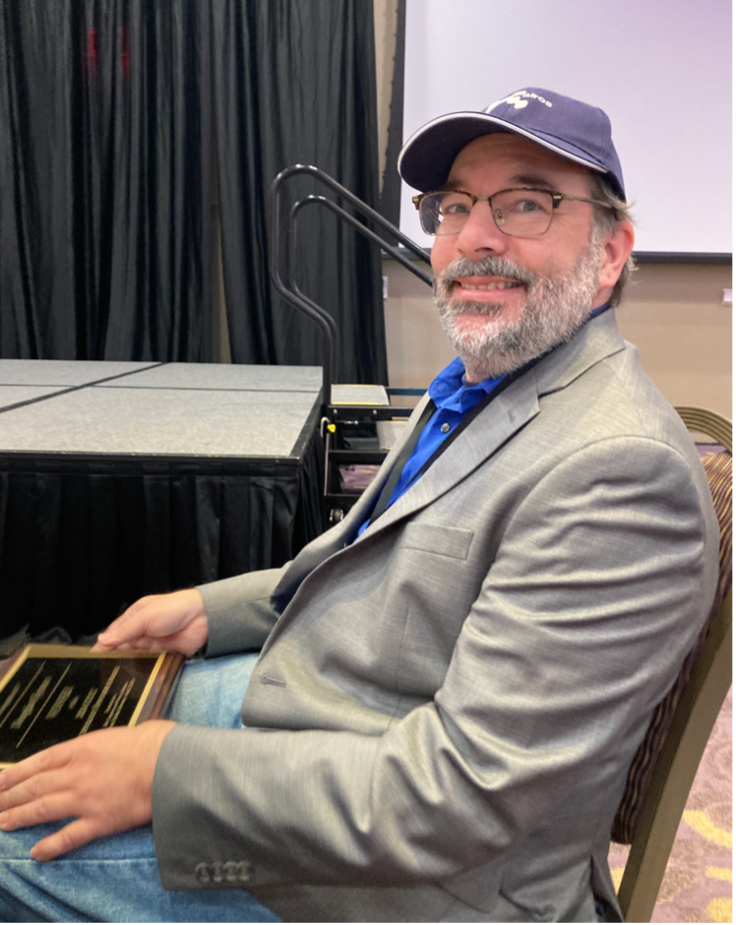
And then he and I went on to host drinks at the bar afterwards, as we do. There was no karaoke or bowling to be had that year. Maybe it was the next night. And we had a fun, delightful time at the bar with 30 or so people from the conference in our hosting duties, or, as some of my friends like to say, me holding court [laughter], sitting in the center of two extended tables, two sets of extended tables, making friends with the bartender, tipping him extra when he stayed late to make sure that we were taken care of, and doing my damnedest to engage with every person there, not always being successful. But I had a different amount of joy, because I just popped in and could celebrate a friend and then leave first thing the next morning. At that point, I knew that 2025 would be my last Computers & Writing.
Part 11: Computers & Writing 2025 (10:58)
Download Part 11: Computers & Writing 2025 (MP3)
I had basically retired from academia. My work with Kairos would be done in August of 2025, and while I was still consulting and working one-on-one with people and loving the mentoring work that I got to use my 30 years of experience helping authors get their projects to completion, I didn't need to be actively involved in the conference anymore, necessarily. So I made plans to go to Georgia, and knew that I would have very few friends left still at the conference, close friends—lots of lovely colleagues in the field who I enjoy seeing, but almost no besties who were the ones who I would sneak away and have a dinner with. And of course, the conference theme very aptly was AI, so I didn't even have to go to very many sessions, because I just don't care.
I went to a beautiful panel that was a festschrift on the abecedary edited collection for Kathy Yancey, and was shocked that besides myself, there were only three people in attendance, two of which were authors in the collection. I think that that's indicative that it's time for us olds to move on, and that's gonna be a fantastic fucking book, and everyone should read it. I unfortunately missed a session led by some fantastic BIPOC scholars on a community journal because I got wrapped up in some other work I needed to get done, and I went to a session on bisexuality on another edited collection that's coming out by Derek Sparby and Cindy Tekobbe. That was a fun, engaging session, but that was it.
I skipped most of the meals because the vegan food at the conference is always a crap shoot. I did go to the opening reception, and I had to zip up energetically because I was worried that it would be a repeat of Davis in a way that would try to suck me back in, but it wasn't. I said hi to my friends. I knew I hugged people that I was grateful to see, but when I walked in, no one shouted my name, no one called me over. And that was okay. That was as it needed to be, and I was grateful for it.
I got a beverage. They had some lovely non-alcoholic beers. And I said hello to a few friends, but I wasn't very chatty until I bolstered some energy and went in the next room that had fewer people in it, to find a chair. I just sat down with some folks I didn't know, and talked with them for a little bit and went back to the questions that I had used in Davis two years earlier about their biggest lessons of the year, when one of the conference attendees shared that he lived in western North Carolina, so last year was a big challenge for him, because of the hurricane. And because of the time that I had spent in Asheville, both before and after the hurricane, I knew well of his struggle, and it was nice to be able to talk about something of depth and substance with someone I really didn't know. That wasn't about research or the discipline.
And I got to tell a few folks about my nomad life. People are always entertained by that, and that brings me joy. Because the one thing that brings me joy more than anything these days is thinking about my pending move to Maine and the 27 acres of land that I'm closing on next week, and the tiny house community that I'm going to build with my own hands, with help from other carpentry friends. And the new communities that I'm going to create there with a different purpose, but actually the same purpose, just a different group of people. The purpose is always community building, and I will always love to do that.
The few people that I didn't want to run into at the conference, because I'm very bad at my own boundaries? Turns out they weren't even there this year. At the banquet, getting to award awards to several people I know, personally and projects that I have loved, that I feel are some of the most groundbreaking things that we published—that was amazing. And it was a good vegan dinner with a vegan panna cotta for dessert. Yum!
And afterwards, my last Kairos karaoke, co-hosted this year with the Digital Rhetoric Collaborative, so Naomi Silver and Simone Sessolo were also there to help host. It was extra special because we got to have our own karaoke room that sat 25 people, though there may have been as many as 35 in there at one point, or at least in and out. And we got to buy drinks for everybody, as we like to do, though they were a little more expensive this year because people are into the cocktails, and there weren't draft or pitchers to be bought. [Laughter]
I got to sing four songs. I kicked it all off for everybody with my mainstay, "Suspicious Minds." And then people jumped in after that, of varying singing capacities, which was a delight, and we could just enjoy each other's company and drink our beverages and sing the songs that we wanted to sing. I performed my host duties, inviting people up to sing, and helping them with the karaoke little number-puncher thing, and being very gracious to the server, who was amazing and had to carry dozens of drinks up and down two flights of stairs to get to where we were, and encouraging people who were shy to sing, who ended up having beautiful, amazing voices. And, to be honest, I didn't know the names of most of them. I had no idea who they were in the discipline, there was maybe six or eight people in the room who I knew their names, four or five of which I was friends with, and only two I was close friends with, Doug [Eyman] and Derek [Mueller].
Part 12: Final Karaoke Song (7:06)
Download Part 12: Final Karaoke Song (MP3)
I had really been practicing to sing, and I had teased Doug [Eyman] that he would have to sing the Miley Cyrus and Beyoncé duet with me, "II Most Wanted," and it would be extra hilarious because of our longstanding co-editorship as it was, basically like a bisexual love song, or a lesbian love song, as I sometimes refer to it.
Earlier that evening, before we walked over to the karaoke together, I had driven Doug back over to and parked at my hotel because it was right next to karaoke, and he said, "I haven't been able to practice the song. I don't know the lyrics. Can't we sing something else? And can't I sing the Miley Cyrus part because it's in my range?" And I said, "No, the Miley Cyrus part is in my range, and I like it, so I wanted to sing it." And we're having this conversation as we're driving, as I'm driving up level after level in the parking garage, passing dozens of empty parking spaces. And finally, Doug interrupts me and says, "Where are you going?!" [Laughter]
We have been talking about also, how at ECU, the year that C&W was at ECU, I saw these people parkouring off of the parking garage that I was parking in next to the student center where the conference was being held. And, like, how bizarre that was. And Doug was like, "That wasn't any of our people, was it?" And I was like, "No, no, no, it was other people."
And he's like, "Are we gonna..." and I said, "It's too bad we have to walk around the block because Shokitini, the karaoke bar, is literally right behind the parking garage." And so as I'm driving up level after level, he says, "Are we planning on parkouring off the back of this thing?"
And I laughed, and I was like, "No!"
And he's like, "Are we just gonna drive off the edge?" And I laughed.
And he's like, "Well, if we we're gonna Thelma and Louise this," he's like, "I wouldn't want to do it with anybody but you."
And I was like, "Oh, that's so sweet." [Laughter] That's about as sweet as Doug gets, so I'll take it, and that's kind of what the song "II Most Wanted" feels like. But they didn't have "II Most Wanted" in the karaoke book, and perhaps the book was out of date, but Cowboy Carter is also relatively new, and there was another song that was less difficult on Cowboy Carter that's right before "II Most Wanted." When I listen to that album, I tend to listen to it from start to finish, and then on repeat when I'm on long road trips. And this other song I didn't think I liked initially, and then the day or two before the conference, as I was driving to Athens [Georgia], I had this lyric in my head that I kept singing over and over. And I knew it was from Cowboy Carter, but I couldn't remember which song it was. And I said, "Wow, is it from that song that's right before 'II Most Wanted'?" So I played the album, and I got to that song, and it's called — and I went back to it, like, I fast forward to "II Most Wanted," and reversed back to listen to it again, to listen to the previous song, and it's called "Just for Fun." And I started singing along to it, and realized, in a way, it was my departing anthem for C&W and a bit for Kairos. But I decided I wanted to sing that at karaoke, if it were available, plus it was spectacularly in my range.
The song starts [singing off-key, in incorrect lyrics] "Going downtown, just for fun, because I, I am the man. I know it, and everybody knows my name. We're laughing and crying, the coyotes crying, and time moves quickly, but so do I. So I'll say my goodbye. Cuz time heals everything. I don't need anything. Hallelujah."
And then it goes on from there. It's a beautiful, poignant song with a with a note of grief, with its requisite sadness, but also with a possibility of just being in the moment with joy and having tremendous hope for the future.
And so while that song was not available at karaoke, which was probably good, and instead, Doug and I sang "Wrecking Ball," which was fabulous, and frankly, more apt to our editorial relationship. [Laughter] And also in my range. I feel like that last night of karaoke was a wonderful send off.
Part 13: Final Thoughts (4:26)
Download Part 13: Final Thoughts (MP3)
And so, as I've narrated this story of multiple years intertwining... My heart and my head, my heart only has a pebble of heaviness. My body is light, feathery. My mind is on the road ahead of me as I make my way to my next great adventure in this life. To Maine, to the tiny house community, to thank my old friends and colleagues who will always be, and to my new friends and community members and colleagues who shall be: I am grateful to the Universe for providing me this, the blueprints for this life that I have lived to its fullest, that have allowed me the lessons in saying no, "Cheryl says no," hard learned over many years so that the decisions become easier and easier, the boundaries become stronger and stronger, the choices for yes become the joy of my existence.
I love you all! And I am so grateful for the space that you've allowed me to occupy in the discipline these last 25 years. I'm incredibly grateful to each opportunity that I've had, to every person who has been willing to bear witness to my growth, and to my amazing close friends who want me around and still have the heart and the kindness to ask me, "Why are you still here?", knowing that that question comes from a place of love and hope and knowledge that I have more things to do in this world, and now I am ready.