Fatmata's Song
| Accessible Plain Text Transcript
[voice] at some point
you gotta decide
for yourself
who you gon' be
can't let nobody
make that decision
for you

even though I couldn't see
past what was going on
I kept going

this is hard for me
but my mother taught me
to use my voice
even when it shakes

to be proud of who I am
& to live unapologetically

that journey is not linear

& I know that words
hold no volumes
unless spoken with conviction

my mom's from Cape Verde
& my dad's from Sierra Leone
Cape Verde is where I was born
I grew up in Jersey City

I was under DACA

because you know I am
all of those things
at the same time

I pray to paint stars
on the insides of your eyelids
so you'd never have
another nightmare

the art of gathering

I hope when it comes time
to say goodbye
your mom has a harder time
than I do

we were just looking
for answers
to the questions
you were too afraid
to ask

identity & gender & sexuality
are not cut dry
like perforated kitchen towels
there is no black & white
because the sky is light blue
& sometimes pink
& orange & gray & purple

nature doesn't give a care
because she knows that
change & diversity
are beautiful &

the first caterpillar
to have turned into
a butterfly must have
been like holy shit guys!

even though I couldn't see
past what was going on
I kept going

this is hard for me
but my mother taught me
to use my voice
even when it shakes

to be proud of who I am
& to live unapologetically

that journey is not linear

& I know that words
hold no volumes
unless spoken with conviction

when I wrote that poem
right after that
I went to my first Pride
that summer
I went to my first Pride
with my then girlfriend
and um, I thought about the poem
& how much this issue
like meant to me

& if I'm sick I'm going to start
calling in queer to school
"hello, this is G,
how's Fatmata doing?"

"oh she's still gay,
she can't stop thinking
about boobs again"

part of like my healing process
just embracing the grittier
parts of ourselves

& maybe humans
are the only creatures
that have an issue
with homosexuality
because we have such
shitty hearing

that poem was I think like
the start of me starting to feel
better about like who I was

you know, if it inspires one person
then it's, then it's gonna be worth it

even though I couldn't see
past what was going on
I kept going

this is hard for me
but my mother taught me
to use my voice
even when it shakes

to be proud of who I am
& to live unapologetically

that journey is not linear

& I know that words
hold no volumes
unless spoken with conviction

when you share with people
through art
it generates intimacy

to see the profound effect
that it has on someone
five, ten, fifteen years later

how much love
& commitment
that we had
to this little community
that we built
that focused around like
art & storytelling

do you necessarily
have to, you know,
write a certain way
to be able to be
considered literate?

how can we learn in a world
where only the young &
dumb are honest?

so after I did my first poem
on stage &
let it all out there
that's when I felt like
yea, I got it

I think like for me
healing looked like
being kinder to myself

that's when you get to know
your students really intimately
through their writing

it will be the intro
to the song we sing
to the children

even though I couldn't see
past what was going on
I kept going

this is hard for me
but my mother taught me
to use my voice
even when it shakes

to be proud of who I am
& to live unapologetically

that journey is not linear

& I know that words
hold no volumes
unless spoken with conviction

I was just like, wow we did something really incredible
Keep Going: Humor, Identity, and Resistance
Fatmata is hilarious. We get a glimpse of her dry, sarcastic sense of humor in this song, but it doesn't do justice to the brilliant ways she used humor in her poetry to lighten the mood and make us laugh. Laughter is one of my favorite sounds. It's an elixir. And Fatmata made me laugh often. At the same time, she was going through a lot during her teenage years. As an undocumented child of immigrants from Cape Verde and Sierra Leone, she was under the Deferred Action for Childhood Arrivals (DACA) program during high school. During our interviews, Fatmata recounted how stressful it was to worry about getting deported and having limited access to resources like financial aid for college.
Additionally, Fatmata was struggling with her mental health during high school and trying to make sense of her own sexual identity. During one of our conversations, we spoke about intersectionality and the overlapping systems of oppression that she experienced as a gay, Black, undocumented woman. She joked that if people wanted to hate her, all they had to do was "pick one" of these identities. Certainly, Fatmata uses humor to cope, process, and deal with the harsh realities she faced—although she told me she is in a completely different space today. There were very emotional moments in our conversations, times when I wasn't sure if I should continue asking her questions because I didn't want her to reexperience trauma for the sake of research. Then she would compose herself, make a joke, or turn our attention to a joyful memory, of which she had many.
When I asked Fatmata what she was most proud of about the younger version of herself, she stated, "I'm most proud of the fact that even though I couldn't see past what was going on, I kept going." While I knew about some of the challenges she faced in high school, others I was unaware of, including her dyslexia. I didn't have Fatmata in my traditional English courses during the day, so we only worked together in an extracurricular context after school through the slam poetry club. I wasn't invested in "grading" her writing or assessing it in a formal sense. She asked, "do you have to write a certain way to be considered literate?" as she reflected back on her challenges with reading and writing.
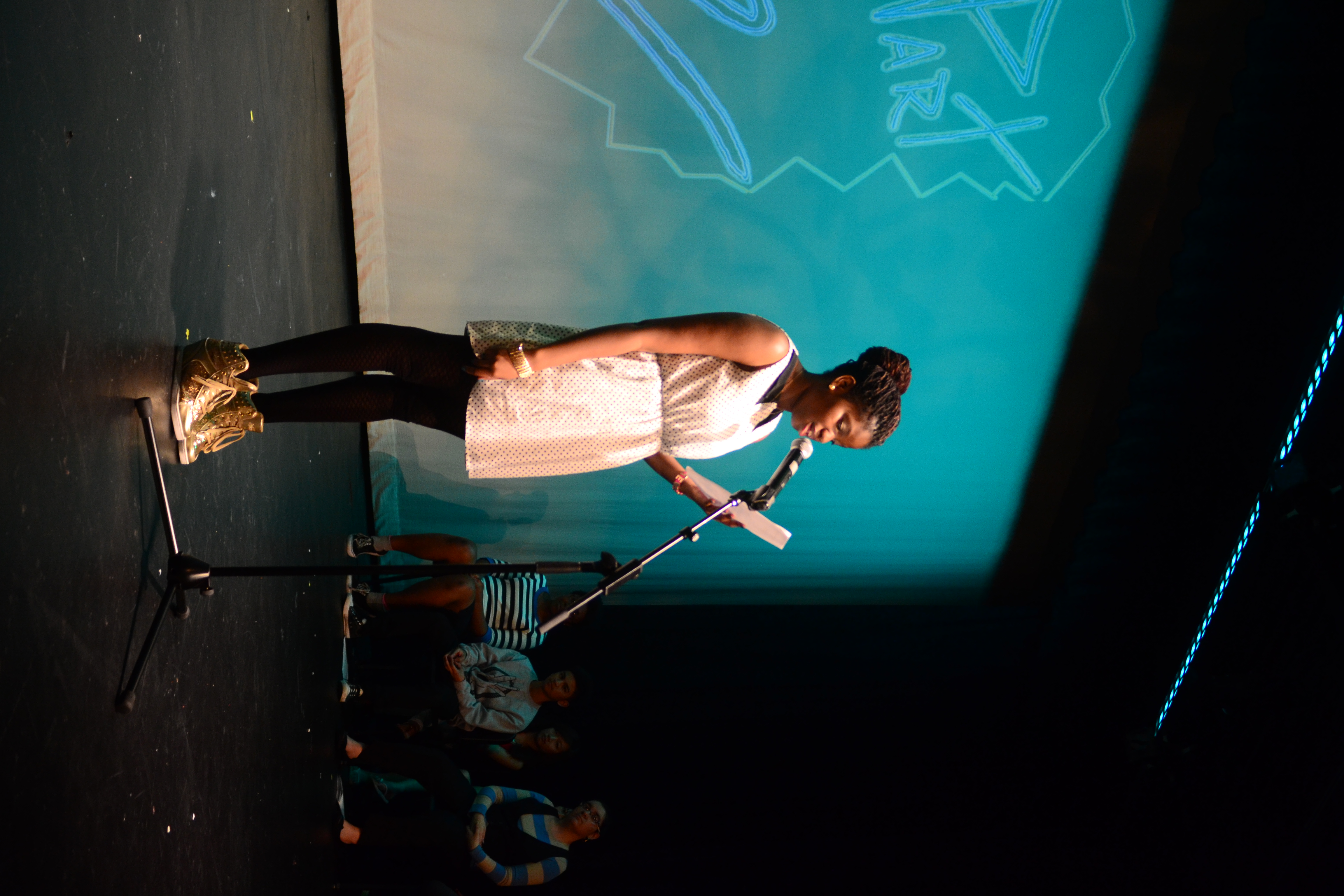
Fatmata described having trouble spelling, writing, and trying to memorize poems. She recalled that I "never pressured" her to memorize a poem to perform on stage. Fatmata insisted she could "read and speak really well." Even in progressive educational spaces, we can limit the brilliance of young people with artificial restrictions that prevent them from bringing their full selves to the classroom. If I had pressured Fatmata to memorize her poems, a common practice in some youth poetry spaces, she may have never found the courage to get on stage and share her poetry with us. Fatmata's story pushes us to reimagine what counts as literacy and who gets to be seen as literate.
Writing, Pride, and Claiming Joy
One of the most memorable poems that Fatmata performed during her time in high school was called "Princess Charming," which addressed her concern about gay marriage—which at the time was not yet legalized by the U.S. Supreme Court. She asked, "what am I supposed to do? / get on one knee and ask / will you civil union me?" We spent a great deal of time talking about the importance of this poem, which infused humor and social commentary in a way only Fatmata could. At another slam, she shared a love poem addressed to her girlfriend of the time. Today, they are legally married.
When Fatmata recalled her poem about gay marriage and sexual identity, she talked about going to her first Pride (The New York City Pride March) the summer after she wrote it. While she was at Pride, she was thinking about the poem and how much it meant to her. She told me the poem was "the start of me starting to feel better about who I was." As she shared this story with me, I thought about the power of creating learning experiences that are so deeply personal and relevant that young people are thinking about them outside of school while invested in activities that matter to them. I reflected on the significance of that poem, at that particular moment in history prior to the U.S. Supreme Court decision, and how Fatmata was writing and archiving history through her poetry. When she spoke about marrying her partner and eventually getting her green card, she was filled with a joy I could see and hear in her voice. In this project, Fatmata's poem becomes part of a living archive that contributes to a growing canon of youth-authored texts that challenge notions of authorship, literacy, and composition.
The Sounds of Healing
When Fatmata described the process of "starting to feel better about who I was," she talked about healing as a "journey [that] is not linear" or binary. We are not either (a) healed or (b) broken, but perhaps always somewhere in between, which she said is true of gender and sexuality as well. Fatmata suggested a spectrum of healing. She explained that "part of my healing process [was] just embracing the grittier parts of ourselves." When I asked about this, she explained that our study of Hip Hop and spoken word enabled her to "be proud of who I am and to live unapologetically." Fatmata told me she was healing from "what I projected onto myself and what society was projecting onto me." This is a powerful insight that demonstrates thoughtful introspection, emotional literacy, and sociopolitical consciousness.
I shared with Fatmata about my own struggles with addiction and mental illness, describing what my healing process looks like. Her process, she told me, "looked like being kinder to myself." Fatmata and I found so many points of connection and identification that reminded us of our shared humanity, dignity, and self-worth. I began to understand this research project as a form of sonic healing for me (and hopefully for my participants). WAVEFORMS is a collection of sounds that I will carry with me forever.
Memory Remixed
One of the most fascinating elements of this study has been the nature of doing sonic retrospective work and hearing our experiences from new vantage points. All of my collaborators pointed out the power of looking back and considered how those experiences shaped us. Fatmata, in particular, commented on the "profound effect it has on someone / five, ten, fifteen years later" as she thought about the impact of our work together. When I showed her a video of herself performing a poem as a teenager, she lit up with excitement and said, "I'm so proud of little me!" What happens when we reintroduce ourselves to ourselves—to a younger version of who we once were? How does sound activate our senses and transport us to other dimensions—to other worlds, both familiar and unfamiliar? These lingering questions, among others, have propelled me through time as I consider my own past, present, and future as a teacher-educator, scholar-artist, and multimodal researcher. These conversations seemed to return me to myself with a deeper resonance as we reassembled ourselves into new forms, new modes, and new futures.