Otto's Song
| Accessible Plain Text Transcript
[voice] light flows through all
through the great machine

first there was a people
then there was      smoke

then there was children
of that      smoke

I could have been a ghost
before I even died
protect what the fire left
& what the fire left      was me

conceptual ideas become
physical spaces

metaphor was discovery

spinal cord of stone

words conjure things

the chorus is,
"I can run the world
from my momma's house"

the funk of it

that quantum part of      words

sometimes I find the poem
writhing on the floor
twisting like a potion

I, too, was born
needing a way out
before knowing
what I needed to escape from

first there was a people
then there was      smoke

then there was children
of that      smoke

I could have been a ghost
before I even died

protect what the fire left
and what the fire left      was me

I've been thinking a lot about
my Jewish identity
in terms of queerness & anticolonialism

I'd be another      nothing
under history's rotting tongue

I've been thinking about
a decolonized Judaism for a while

I recognize it
because it's      Love
but it looks nothing like mine

records      of where each
of my ancestors
became a      ghost

do you know how many
trans people      disappear
into their own hands
& leave this world
without a      sound?

the grief of metamorphosis
& the metamorphosis of grief

in that world
everything is mine
or it's kindling

first there was a people
then there was      smoke

then there was children
of that      smoke

I could have been a ghost
before I even died

protect what the fire left
& what the fire left      was me

those genocides play out
not just in a gas chamber
but in your schooling of your thing
the way you were moved
around in the world
what neighborhoods
you're allowed to live in

I've noticed I am my best teacher
or creating my best teaching
when I am co-authoring

I wish I showed up
to myself, too, sometimes

poem as exhibit

— what if they walk through it
in a different order than you curated
right? & then you have a new thing

you think I want to archive
my friend into      memoria
just to keep them alive?

sometimes when writing about my own gender
I feel like I'm writing into my future gravestone
but in this space

I feel like I'm tending a garden
I feel joy
I grow flowers

the color of my dead      friend's
lilac hair in these margins
because that's the closest thing

I'll ever see her smile again

first there was a people
then there was      smoke

then there was children
of that      smoke

I could have been a ghost
before I even died

protect what the fire left
& what the fire left      was me

this is my last Word Up
& it is really, really painful
& hard for me
this event has been really transformative
I wouldn't be where I am without this event
without the work that Mooney does
without all of this work
& without the people who come like you
so thank you from the bottom of my heart
Tunes, Riffs, and Licks
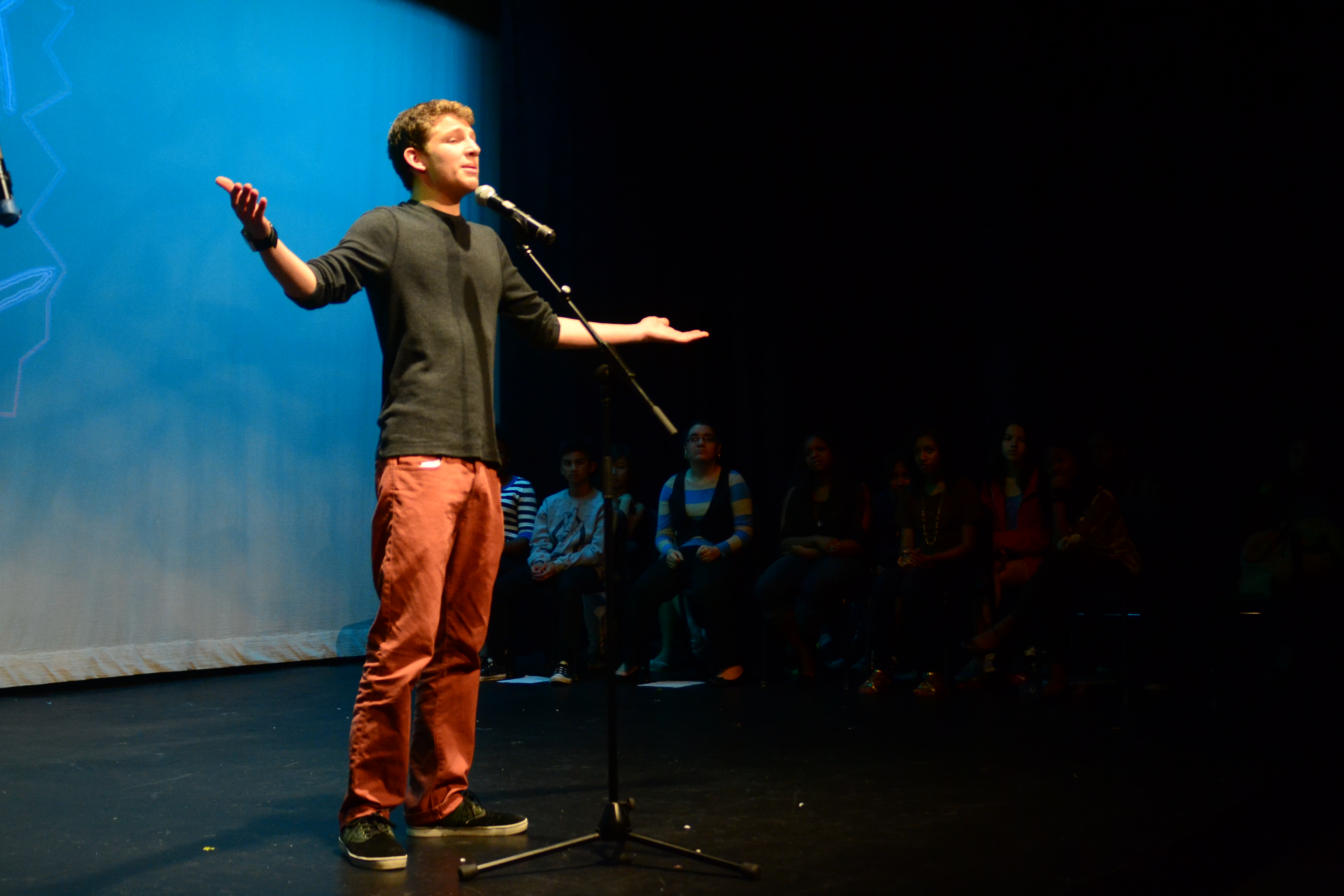
Otto (they/them) is a Jewish, nonbinary poet from Jersey City. We've known each other for more than ten years and stayed in touch over that time. Otto is one of the few students who continued writing, performing, and teaching poetry after high school. As a teaching-artist, they have worked with various nonprofits, youth arts organizations, and public school districts. In my earlier work (2016), I discussed how Otto explored gender and masculinity through poetry and how they helped me come to a more nuanced understanding of my own gender identity. In this way, Otto's presence in this project reaffirms a key aim of the webtext: to center youth literacies while reshaping how we understand knowledge production through a nonbinary spectrum of modalities.
As we reflected back on our experiences together, Otto recalled memories with poetry as (trans)formative experiences that shaped them into the person they are today. Our interviews were full of joy and laughter and poems. We read old and new work to one another, picking up almost right where we left off before Otto went away to college. As we began to think about composing a song together, many meaningful parts of Otto's identity emerged, including their love of video games, technology, and music. We discussed the stunning and imaginative world-building of games like Destiny and Zelda—not so different from the world-building in poems or musical compositions. The original soundtracks (OSTs) of video games like Destiny became a generative source of samples for "Otto's Song."
Another hobby that Otto took up in recent years is making custom computer keyboards. We decided to sample the sound of Otto pressing buttons on one of these keyboards as a texture for the track. This sample became a layer of percussion in the final composition. During high school, Otto played guitar as a music major in our high school's performing arts department. I asked if they had any old recordings we could sample for the song. Otto told me they still had "all these [unfinished] tunes and riffs and licks." After a little searching, we found an old recording of Otto playing guitar, which makes up one of the melodic leads for the song we composed together. This blend of guitar riffs, keyboard sounds, and game aesthetics functions as both sonic data and symbolic texture, a personalized soundscape that embodies Otto's layered intersectional identities.
Decolonized Judaism
During our interviews, Otto read poems about Jewish identity. They told me about how they've "been thinking a lot about my Jewish identity in terms of queerness and anticolonialism" and over the years have been contemplating a "decolonized Judaism." Otto criticized the occupation of Palestine and distinguished between Judaism and Israeli statehood, reflecting on what makes something a home(land), which reminded me of conversations with Edsel. As a person and artist committed to social justice, Otto demonstrated a sensitivity to the humanity of all people, including their Jewish ancestors and the trans community.
In many respects, Otto's poetry speaks for itself. There is always so much to say—and yet, to be left unsaid. Some of Otto's newer poems, which explore their identity as a descendant of the Holocaust, leave space for the unsaid / the erased / the ghosts between the words / honoring that absence through silence. They remembered how "first there was a people / then there was smoke." Otto then suggests, "what the fire left / was me." They talked at length about the impact of "generational trauma" and "historical memory," which resonated from my conversations with Aaleah.
Queering the Soundscape
One summer when Otto was home from college, we got together to catch up. Earlier that year, one of Otto's friends at school, a trans woman, took her own life. I remember hearing the grief in Otto's voice and trying to find the right words to console and comfort. It wasn't until recently that I discovered the poem Otto wrote in dedication to this friend, which asks "you think I want to archive / my friend into memoria / just to keep them alive?" That poem, sampled here in the song, speaks to the ways Otto uses poetry to make sense of an "inheritance I'm sorting through." If inheritance is something given to us from the past, how do we make sense of it in the present and what is its role in our futures? What do we do with an inheritance of loss? And what does inheritance sound like when we claim it in our writing and creative work?
Although many of the poems Otto shared with me document trauma and loss, there is also a very present and intentional joy in their work. In the poem referenced above about the loss of their friend, Otto writes, "but in this space / I feel like I'm tending a garden / I feel joy / I grow flowers." This joy was present in our interviews when we reflected on our time together. At one point, we found ourselves laughing uncontrollably, struggling to catch our breath after Otto made a joke about Neo from The Matrix, whom the Wachowski sisters (both trans women who produced the film) have described as a metaphor for the trans experience. And it is this sound of laughter that lingers, persists, and remains with me more than any other.
Otto's poetry invites a close reading of queer theory, particularly Judith Butler's (1990) argument that gender is not an essentialized category, but a repeated, socially constructed performance. "Otto's Song" adds a sonic and compositional dimension to this claim. Gender, in Otto's poems, is remixed. It's troubled on the page and stage. It's layered with silence, distortion, repetition, collision, and overlap; each of these effects can be understood as compositional techniques. On the page, Otto's use of erasure and negative space queers the poem itself, troubling expectations of what a poem should sound like, how it should resolve, and whose voice is allowed to linger in the margins. On the stage, Otto simultaneously embodies and disembodies language, pushing it toward the edge of collapse.
In this sense, Otto's work extends Butler's theorization beyond the body. When Otto asks whether they want to "archive" their friend into memoria, the question is not only about grief, but also memory, authorship, and representation. Their refusal to resolve loss into narrative coherence becomes a queer compositional practice that affirms absence as fundamental to meaning.
Poem as Exhibit
As Otto and I walked through these experiences together, it felt almost like visiting a museum that had different rooms and galleries from our past. We began to talk about remixing those experiences into something new. Otto described our collaborative process as "remixing the random schema of our experiences" and "splicing, flipping, or remixing" our memories. The very act of conjuring memory and re-membering constitutes a certain kind of remix. When I asked Otto how they understood poetry now, they talked about the "poem as exhibit," as something you curate, and wondered aloud what happens if your reader or listener "walks through it in a different order than you curated?" They went on to suggest, "then you have a new thing." I thought about my own research as a kind of exhibit that is curated for those who visit the site—and how an album or mixtape format supports a certain form of agency for the reader/listener because they can choose to walk through it in a different order than the track list suggests. Put it on shuffle! Listen on repeat! Start at the end and finish at the beginning! Albums, mixtapes, and playlists have a specific order, but this order can be altered to provide a personalized modular experience.
Each of the songs I created with my collaborators, including Otto's, became an exhibit of artifacts. The words are disjointed, out of context, jumbled, colliding, and overlapping—yet thematically organized and tied together in one cohesive exhibit. Otto believes that "where beauty or new insight happens is when you find proximity of two concepts that were once distant." Each of these compositions puts words from different points of origin into spatio-temporal proximity, thereby creating new meanings that didn't exist before. In essence, this is what a poem does. Otto deepened my thinking about this idea by using the language of music to describe poetry. They recalled how "theme, variation, and repetition" create complexity over time. These devices connect music and poetry in fundamental ways. Just as Otto described the "poem as exhibit," this webtext functions as a nonlinear digital gallery that invites readers to curate their own experience as active participants to the site.