Courtney Thayer
Wild animals, prodigious mountain ranges, and powerful rivers were just a few of the tremendous risks facing the frontiersmen of the late nineteenth century. In their spirit of Manifest Destiny and pursuit of “unconquered” territory, it seems the “Wild West,” as it is now referred to, was just that. By using the new historicist approach to analyze the Disney poster for the Big Thunder Mountain Railroad ride and frontier spirit, I will be looking at the previous historical facts and studying the background and context of this text.
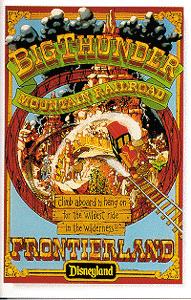
Despite the recent romanticism of our heritage through movies and songs, it appears that the Disney poster depicting the Big Thunder Mountain Railroad ride and the spirit of the old west in Frontierland is historically accurate on the surface. However, upon closer examination, there are also many discrepancies.
Possibly the most important aspect of analyzing the poster is to identify the context. Time period is just the first aspect that appears correct on the surface but upon further analysis is quite different. Despite the fact that both the poster and ride claim to take the tourist back to the 1890s, it seems more accurate in several points to be more fitting for mid-nineteenth century America. The California gold rush began in 1849 when an estimated 90,000 miners arrived in California (“Gold Rush” online). Although the gold rush and travel west did continue through the late 1800s, by 1858, over 600,000 men, women and children had visited the mines (“Gold Rush” online). Most of the families also came and soon returned home, which is further evidence that the ride is more suited for mid-nineteenth century than the 1890s.
Also having to do with the gold rush are the facts dealing with mining. Several different methods of mining were used including hydraulic and quartz mining, which were developed during the late nineteenth century. One previously existing procedure was placer mining or simply looking in streams and water for gold. These new developments were complicated and often required professional help which led to the formation of the miner class. Commerce began to circulate around these mines, and unions were even formed for the miners. Looking at the miners of that day is helpful in analyzing the poster since the Disney version suggests that the modern tourist can jump in and catch the real spirit of the old west. In reality, miners were trained men who spent the majority of their lives struggling to make a living. In any case, they were not people straight off a jet looking for an overgrown mouse. The evidence of mining and the gold rush is the second example of how the facts are in agreement with the poster at first glance but quite different on a deeper level.
The most predominant part of the poster is the train zooming its happy tourists through the perils of the wilderness. Similar to many periods of American history, Antebellum America was a time of expansion and profound growth. The railroad system was not an exception to this generalized statement growing from just 23 miles of tracks in 1815 to approximately 30,626 miles by 1860 (note). As suggested in the Disney poster, the railroad was extremely important to the 1800s and led to further expansion and development. As far as the railways are concerned, the poster is historically accurate portraying the train as a symbol of not only transportation but also the emergence of new technology.
Nearly every issue of national importance during Antebellum America had two conflicting sides. Territorial expansion fit into this category in that it both helped and harmed national unity. The “Young America” movement in which the public heralded a nation on the move onward, upward, and westward was a compelling force towards national unity. These Americans felt that nothing could stop their adolescent country from maturing and expanding. The second major movement was the sentiment of “Manifest Destiny.” Manifest Destiny is best described as the belief that expansion to the Pacific Ocean was America’s God-given destiny. Both of these movements united Americans because they gave citizens from any area of the country a common goal creating a sentiment of nationalism. This view of the expansionism agrees heavily with the Disney poster of the old west. Disney’s poster suggests that expansion was the only choice and that it was generally accepted and agreed to by everyone.
Although the majority of the American public agreed with the feelings of Manifest Destiny and the Young America outlook, there was an opposing side. The 1800s were a time of slavery, and expanding would force the question of whether Texas, California and Oregon should be admitted as free or slave states. Northerners felt that the South was trying to expand to form more slave states thereby upsetting the balance between free and slave states. A second opposing view came from the Native Americans who already inhabited the land. Despite the fact that their opinions were not consulted, the Native Americans were adamantly opposed to expansion. These opinions contributed to a feeling of dissension and conflict between the North and South and hurt national unity. The opposing side of expansionism doesn’t agree with Disney’s poster. It is true that, as a whole, expansionism promoted national unity, and the feeling of pro-expansionism is the factor that Disney relies on for its poster of Big Thunder Mountain. That being said, it is also important to look at every aspect of the westward expansion and it must be stated that the poster is not in total agreement with the historical facts.
In researching America in the nineteenth century, I found that the Disney poster of Big Thunder Mountain Railroad agrees with history only on the surface. As is the issue in many cases, there are two sides to every aspect in the poster. Disney did a good job of using the most prevalent sentiments and facts however; things such as time periods should be more accurate. Overall, the poster suggests that Disney took the stereotypical version of the west as opposed to the carefully researched, more complex view.
Work Cited
“Gold Rush” Online. Available: http://www.goldrush1849.com. Date of Access: October 27,1999.
Endnote
1. The source
of this material is a study guide I made in high school for the A.P. U.S.
History exam. (back)