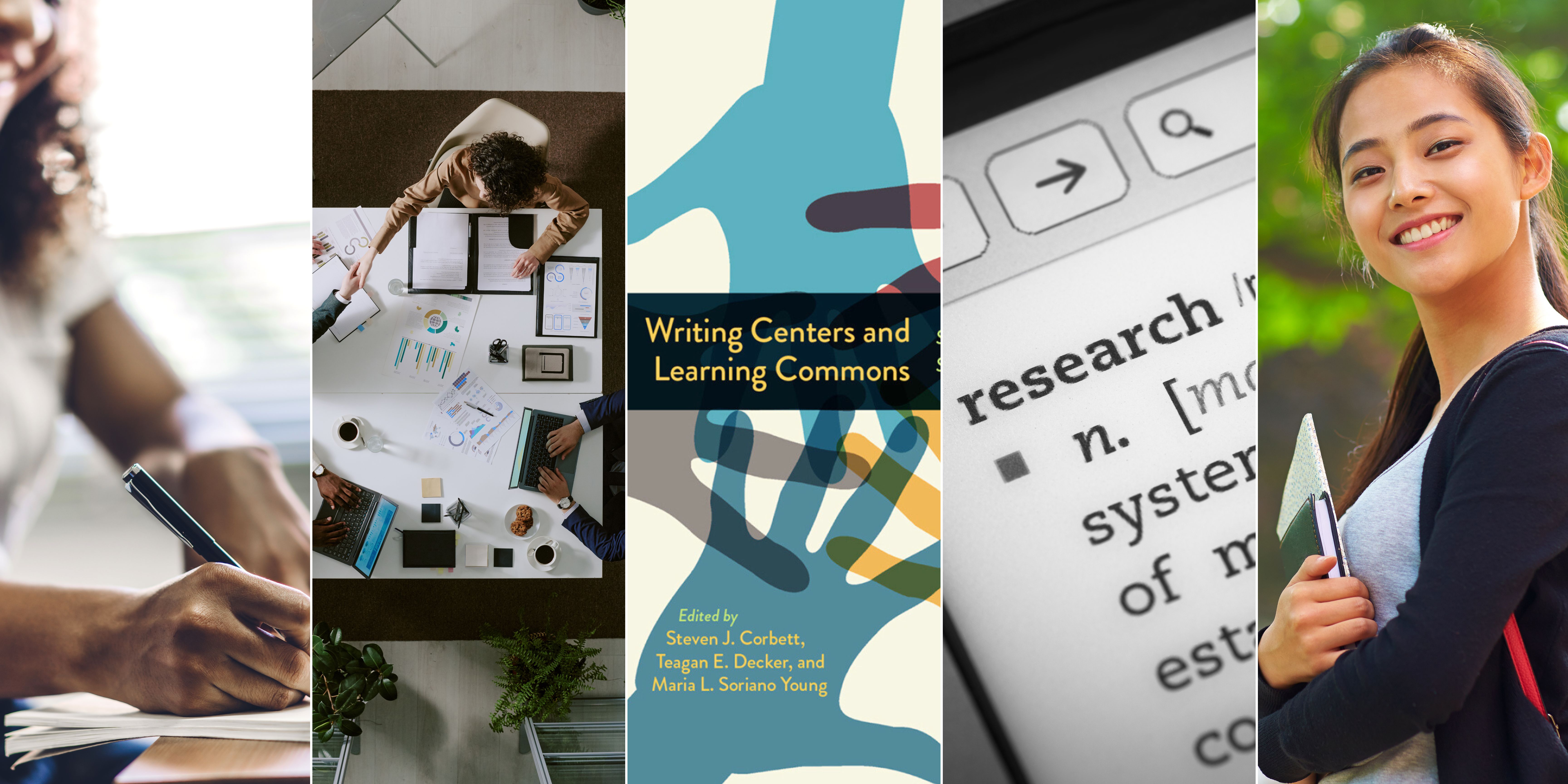
Welcome to "Writing Centers and Learning Commons: Staying Centered While Sharing Common Ground: A Review." A transcript is available here.
Higher education is changing. It's not a bad thing, but like any change it comes with some growing pains, ideological, practical, and otherwise. Writing centers are not inoculated against these inevitable shifts. Fortunately, over the years, writing centers in general have demonstrated a willingness to adapt, to change, recreating ourselves in response to new understandings, available resources, technological advancement, shifts in institutional identity, and potential partnerships that can help us fulfill our mission of student learning and success. As a field and as individual centers, we generally manage to innovate with great creativity within specific historical and institutional contexts while conserving the essential parts of who we are. And therein, I think, lies the real challenge and some pressing questions: how do writing centers navigate transitions successfully, sometimes even giving up autonomy and agreeing to share resources for "the greater good," without sacrificing our core mission? Might such transitions even be good for our centers and for the field?
My name is Jeffrey Howard, and this podcast provides a review of an edited collection that engages with these and related questions. The collection discusses the relationship between writing centers and different incarnations of the learning commons model in higher education. The collection, published in 2023, is called Writing Centers and Learning Commons: Staying Centered While Sharing Common Ground, edited by Steven J. Corbett, Teagan E. Decker, and Maria L. Soriano Young.
In this podcast, I want to discuss the four main sections of the collection: "Grand Narratives and Spirited Metaphors"; "Peripheral Visions"; "The Writing Center, the Library, and the Learning Commons Connection"; and, finally, "Cautious Optimisms." My hope is that this podcast provides a clear sense of what the book offers in terms of critical conversations and new ideas about what it means to be a writing center in the twenty-first century, especially when writing centers are faced with the potential reality of working (by choice or necessity or both) in close proximity to or under a common umbrella with other entities such as university and public libraries, centers for teaching and learning, content area tutoring, career services, and other organizations. Having examples, such as are presented in this collection, of writing centers that have managed to hold onto essential pedagogical and ethical values while changing how they look, how they work, and who they work alongside, can be extremely beneficial to other writing center professionals and our field.
Like so many other monographs and edited collections in writing center studies, this book begins by examining what a writing center is. While this is a well-worn avenue for critical inquiry (yes, Stephen North (1984) will never not be with us), in this case it makes a lot of sense to start with the physical spaces and metaphorical conceptions of writing centers because the purpose of the book is to re-imagine our spaces and our constructs in times of change.
Throughout this collection, it is easy to see how much Jackie Grutsch McKinney's (2013) Peripheral Visions for Writing Centers provides a foundation and shaping influence for the conversations in the book as references to her work appear, it seems, in nearly every chapter. In this section, the reader is reminded that if we tie ourselves to a single construct or narrative—grand, micro, or otherwise—it becomes challenging to see a writing center in any other light or form than the linguistic and spatial parameters we construct for it. In this way, the first section of the book seeks to open our minds and encourage us to examine our lore and assumptions and traditions, making room for new ways of thinking about our work, spaces, and mission.
The "spirited metaphors" examined in this section provide a fascinating and rich cross-section of perspectives. They push beyond the "comfortable home" metaphor and range from comparisons to "the stratified walls of the Grand Canyon...or the twisted red and black metamorphic rock in the Black Hills" (Blackmon et al., 2023, p. 23) to the similarities between farmers' markets and writing centers and learning commons (Raica-Klotz & Giroux, 2023). This diversity of metaphors carries the implication that the metaphors we have used in the past (and we have known this for some time, I believe) are simply insufficient to convey all of the richness of writing centers as sites of labor, community, and knowledge production today. In the context of writing centers, we need to remember that no metaphor could ever be adequate to describe all that writing centers are, but within the mosaic of meaning produced by these constructs in combination, we start to approach a greater understanding of our field and our communities of practice and what they could be. These new metaphors and associations are in fact evidence that critical examination and reflection are ongoing as we attempt to align our work and values with the needs of current students and institutions.
Such metaphors raise important questions and force us to face uncomfortable realities about our spaces. For example, those in writing center studies might see themselves as doggedly anti-capitalist because of our focus, among other things, on process over product and our preference for transformational relationships over the transactionality implied by the services of the proverbial "fix-it shop." The learning commons, driven by the cachet of "one-stop shopping," can seem to be yet another iteration of capitalism and convenience overshadowing our pedagogical frameworks of learning and care. For that purpose, Raica-Klotz and Giroux (2023) wrote of being "leery" of the learning commons model because it seems to turn students "into mere consumers, courses and degrees are mere commodities, and our tutoring centers are just stores in a suburban shopping mall" (p. 51). At the same time, one also has to question whether we're all just fooling ourselves and whether it is actually possible to escape the business aspects of our work with its emphasis on marketing our wares (literacy and learning) and using statistics to justify budget lines through demonstrable outcomes. Because of our relationship to what Raica-Klotz and Giroux (2023) called the "parent corporation" (i.e. the university) (p. 54), we should probably confront the fact that the writing center cannot be completely anti-capitalist and remain embedded in the economic structures of the neoliberal university. Higher education is and has always been a business, and it shapes how writing centers operate. At the same time, we can, encouragingly, still retain our traditional values and define just what kind of "business" we want to be, which is why the "community writing center as farmer's market" can be so transformative. It reminds us that while we will continue to "be interested in marketing strategies, quality transactions, and the bottom line," we can also still "value community, building, transformation, and social justice" (Raica-Klotz & Giroux, 2023, p. 59). The economics and the mindsets that drive the "one-stop shopping model" that many university administrators are pushing should not prevent us from caring for people's needs and "basic humanity" (Raica-Klotz & Giroux, 2023, p. 58). We can continue to promote access to student support resources, even if that means shifting our identity, sharing spaces and resources, or seeking out new spaces in which to carry out our labor.
By reconceiving these metaphorical constructs, we start to make space for new possibilities, such as that found in the learning commons model. Part of the resistance to the learning commons model derives from the writing center practitioners' anxieties about how the consolidation of units might alter or even damage not just our autonomy, but also our ability to make decisions and apply best practices in our spaces.
One of the issues brought up in this section is something that has plagued writing centers, particularly smaller ones, for a long time: a lack of disciplinary expertise as it pertains to the writing process and to genre. In "Scientific Writing as Multiliteracy: A Study of Disciplinary Limitations in Writing Centers and Learning Commons," Nadler, Miller, and Braman (2023) pointed out that writing centers often try to market themselves as being capable of helping any students or other stakeholders working on a writing project of any kind. Learning commons, too, tend to indulge in this kind of "all things to all people" rhetoric, "that is, learning commons (LC) are designed to address myriad needs while simultaneously not discriminating against types of students" (Nadler et al., 2023, p. 68). The issue is not the intent, but the implementation and reality of such promises. Ultimately, writing centers and learning commons are not always capable of making good, at least not completely, on such messaging because they lack access to people who possess the requisite knowledge of writing in specific disciplines and are frequently incapable of providing training in the many genres that are used throughout our university programs. As a result, they end up being "many things only to some people" (Nadler et al., 2023, p. 69). Smaller centers, like mine, especially, can only employ and train so many tutors, and even if they can find an even distribution of people from across different disciplines, there will always be serious limitations when it comes to the question of disciplinarity and the conventions of disciplines that our people are not a part of. Some larger and better funded centers might seek to close that gap by instituting writing fellows and embedded tutoring programs with people from those disciplines, but, even still, having a single person trying to function as the main source of writing assistance for an entire class or program presents real challenges.
Learning commons provide, through organizational collaboration, a means to address these limitations. By combining their resources, human and otherwise, writing centers can use feedback loops between writing tutors and content-area tutors to give writers the support they seek. By co-locating centers and support services, students can easily go back and forth between resources with their questions and receive feedback on writing and content. Additionally, such proximity also allows for informal and formal cross-training opportunities and conversations that can help tutors, regardless of their discipline, to be more effective when trying to provide support for students from across disciplines. This idea that cross-training can benefit units and people throughout the learning commons ties directly to Virginia Crank's (2023) contribution to this volume entitled "Tradeoffs, not Takeovers: A Learning Center/Writing Center Collaboration for Tutor Training." Crank described how the rich tradition in the field of writing centers of providing pedagogical training can benefit other areas of tutoring that lack that same tradition. Working together with other tutor program directors to create a cross-disciplinary training experience, Crank was able to bring pedagogical resources and frameworks from writing center studies to those tutors who were coming from other programs and disciplines. Crank acknowledged that this collaboration forced her to give up some autonomy and control, the very thing that some of us fear most about a learning commons model. However, while she had to share the training load with people from outside of the field, the "tradeoff" was that the writing center's method and lore could effectively serve as a tide to lift all boats in their respective tutoring programs.
While almost any unit on a given campus could be a potential partner for a writing center, some units are candidates for those kinds of relationships. Many writing centers, including my own, are housed in libraries, for instance, and this section focuses on some important considerations when confronting the possibility of merging writing center and library visions and operations within the learning commons or "information commons" models. At a glance, the impulse to connect these services or resources might seem to be one originated in convenience, like two individuals deciding to tie the knot mainly because they're already living together. On a deeper level, however, this is about making these often co-located services serve students better by drawing on the strengths and purpose of the other.
To make these partnerships work, we can start by examining goals and methods where overlap is already naturally occurring, fostering that common ground in ways that make sense for all involved, even when our self-perceptions and organizational narratives diverge. Writing center tutors, for instance, often work with students on projects or papers that require research, drawing on expertise gained from their own experiences to help those they meet with to evaluate and synthesize their sources. Stock and Julian's (2023) chapter, "Integrating Writing and Research Centers: Student, Writing Tutor, and Research Consultant Perspectives," focused on an initiative that takes common ground to another level of integration: the Research and Writing Center at Brigham Young University, a space in which students can receive writing and research assistance "sequentially...recursively...or jointly" (p. 120). While such an initiative does not come without difficulties, the hope is that by working together these usually separate entities change "perceptions and practices away from the linear, lockstep mode of write first, research second toward the more dynamic and realistic experience of research and writing as integrated, recursive processes" (p. 129). In other words, such integration helps students realize that even though we live in different units, our work is closely connected, and that realization can help students achieve greater success in their coursework and individual learning.
One condition for success touched on in this section involves having the right motivation driving the partnership. In Batt and Ostrow's (2023) chapter "The Tales We Tell: Applying Peripheral Vision to Build a Successful Learning Commons Partnership," we learn of a strategic alliance between a writing center and a library that grew out of a "desire to collaborate for the benefit of our students rather than political pressures" (p. 146). By creating meaningful collaborations where "operational" and "aspirational" goals align and come directly from the observations and planning of those individuals who interact directly with students, successful learning commons partnerships are more likely to succeed and be sustainable over time. As with any high-functioning group project our students experience, the inevitable difficulties that accompany the blending of different entities with divergent learning missions, methods, and academic traditions are easier to overcome when all parties are moving in the same direction with the same purpose.
While one might guess that co-located libraries and writing centers can be willing partners who make each other better, we also have to ask ourselves whether the amount of labor required to sustain such partnerships is ultimately worth it. The answer: it probably is. In that case, we also need to ask what might be preventing us from taking advantage of such partnerships or searching for those opportunities. Celeste Del Russo's (2023) chapter, "'Experts Among Us': Exploring the Recursive Space of Research and Writing Collaboration through Tutor Training," provided one answer, and it comes back to the idea of narrative. During the evolution of writing center studies as a field, we have leaned heavily on images of converted classrooms and damp basements as we talk about the lack of recognition our work has received and the difficulty of securing sufficient resources to fund and support it. Such imagery provides a backdrop against which we are able to contrast our position now, showing how far we have come as individual centers and more broadly as a field since those humble beginnings. But there's a catch: these same narratives of organizational invisibility and marginalization might be keeping us from establishing meaningful partnerships with other stakeholders because we are afraid of losing the ground we have worked hard to gain. Del Russo refers to McKinney's (2013) work when she wrote, "We must resist narratives of writing center space that limit, isolate, and prevent us from developing partnerships with other valuable student resources on campus, such as the library" (Del Russo, 2023, p. 136). It's hard to frame what we do as independent, invisible, or undervalued when collaborating with other entities who must see and appreciate what we do to achieve our common purposes. In the end, writing center directors have to decide which is more valuable to their organizational identity: stories of historical marginalization that reaffirm the many ways writing center work has been successful in spite of being ignored or dismissed or stories of willing and innovative collaborators reaching students and helping them succeed by working in tandem with mission-adjacent units like the library within our local contexts.
Given all of the models provided in the book about the work involved in cultivating worthwhile partnerships around mission, space, and resources, it would be easy to think that this book is shamelessly promoting the idea of the learning commons as a logical step in the evolution of many writing centers. However, that's not really the point, and the aptly named fourth section of the volume, "Cautious Optimisms," is indicative of that. It is true that collaboration will continue to be important for writing centers, but increased collaboration among individual organizations can also bring increased challenges. Negotiations and compromises do not occur easily and need to be carefully considered. If the objectives of the collaboration are oriented in the right direction, as mentioned previously, those difficulties, the price of the collaboration, can be worth it. It's important to remember, though, that each example of a writing center/learning commons approach shared in this book came in response to a particular local situation with specific factors, which ultimately can make it hard to generalize whether the learning commons as a model might prove the right choice for your situation or for mine. The "optimism" arises from knowing that multiple centers currently function within this model and have thrived as a result. The "caution," however, should be ours, knowing that implementing this model is going to be neither easy nor identical to anyone else's situation.
"Cautious Optimisms" also reminds us that writing centers have the opportunity to lead through shifts not only in university restructuring but also in university culture. In general, writing center administrators understand the value of collaboration because people working together is the heart of what writing center tutoring is all about, but writing centers also have to have connections and relationships across the university to operate successfully. In that, we can be culture-setters, particularly when other individuals, departments, and units are not talking to each other at all. Patricia Egbert's (2023) chapter, "Breaking the Silos," examined this idea of "siloing," which she defined as a problematic mentality that "happens when departments within an organization do not want to share information or collaborate with others" (p. 164). Different organizations, including Egbert's, experience this "mind-set" to a greater or less degree, even though the consequences of such a culture are often antithetical to the objectives of the organization. Even writing centers can be complicit in such siloing. Egbert's chapter provides an important reminder that, in being administrators trying to manage our resources and take care of our writing center community, we sometimes forget our own pedagogical training: sessions go better when everyone is involved. The learning commons model is a way for writing centers to apply this understanding in new ways and provide a positive example of collaborative culture-building on our campus.
This volume offers perspectives that can appeal to multiple audiences within the field of writing center studies. Two are of particular importance here. One of these is a practical perspective intended for open-minded writing center administrators looking to the future of their respective centers, searching out ways they can evolve in their structure and services to ensure their continued stability and impact on their campuses. For this audience, being a writing center director means understanding the permeability of the boundaries between what they do and what other student success units do; they embrace the areas of overlapping purpose and mission to raise their profile among their stakeholders and achieve their unit's objectives now and in the future. This might sound easy, but it isn't. In a time of limited resources, when one unit's gain might mean diminishing someone else's allotment of resources, it can feel like the only thing to do is protect what you've got and police the boundaries between your unit and others to emphasize the value you add to the institution. This perspective suggests that that kind of isolationist practice can be antithetical to long-term success as a center.
The other perspective is a philosophical one with a broader appeal to the field of writing center studies that not only leads us to re-examine who we are and why we exist constantly, but it also reminds us that frequently the ideal of autonomy is not only not realistic, but it is also not always the virtue we think it is. If we are willing to lean into our collaborative roots to create more meaningful partnerships, we may find that we not only will have to sacrifice less than we might believe, but we might also find that working more closely with other individuals and organizations will allow us to be more ourselves than ever.
As Egbert (2023) wrote, "For writing centers to survive, evolve, and stay relevant, we must learn to work with others" (p. 176). The learning commons model provides a viable and sustainable means for such collaboration. For some centers, the kinds of collaboration described in this book are ongoing. For others, our collaborative efforts look slightly different, perhaps less structured, but no less impactful. For still others, the learning commons might remain a hypothetical, a thought experiment with a low likelihood of becoming a reality because of our institutional culture, its possible incompatibility with our center's distinct mission, or our own deep-seated resistance to the idea. However, as budgets shrink and institutions change, we probably should be open to the potential benefits of reorganizations, collaborations, and inevitable negotiations that might change what we look like and how we run administratively if it means we can preserve the more essential parts of what we do, what we know, and how we serve. At the very least, Corbett, Decker, and Young's collection demonstrates that with the right partners and proper consideration, the learning commons and the writing center can find common ground and work together to advance the aims of both.

Corbett, Steven J., Decker, Teagan E., and Young, Maria L. Soriano (Eds.). (2023). Writing centers and learning commons: Staying centered while sharing common ground. Utah State University Press.
McKinney, Jackie Grutsch. (2013). Peripheral visions for writing centers. Utah State University Press.
North, Stephen M. (1984). The idea of a writing center. College English, 46(5), 433–446. https://doi.org/10.58680/ce198413354
Stock images and templates provided by Canva. Book cover provided courtesy of University Press of Colorado. Picture of Wilson Hall at Converse University taken by Jeffrey Howard, August 22, 2022.