Shaping Narratives: Exploring A Hybrid Documentary Methodology
By Kelli Lycke Donate
Abstract: This webtext reflects on the hybrid methodology I used in my dissertation research to create a multimedia website centered around short documentaries. The project, called Into Space: Film-book: Public Memory in New Mexico's Central Mining District, combined conventions of academic genres such as introductory chapters, a methodology section, and an index with methods of documentary production. In this webtext, I argue for the value of a hybrid research approach, blending academic research methods with documentary filmmaking techniques. I highlight the potential of documentary filmmaking in capturing and conveying embodied experiences, fostering community engagement, and enriching research methodologies in rhetoric and composition. In this webtext, I address the challenges and ethical considerations I faced in developing Into Space: Film-book, including constructing narratives as a producer and balancing factual accuracy with storytelling. Overall, this webtext offers scholars ideas about how to bridge the gap between academic research and community memory preservation—through the hybridizations of documentary filmmaking and textual genres. To create this webtext, I used the Adobe suite, mainly Adobe Premier Pro and Adobe Audition, to edit the films. I used HTML and CSS to build the static webtext you see.
Keywords: Rhetorical feminist methodologies, documentary film, collective memory, hybrid texts, community engagement, oral history
In fall 2020, I took a documentary production class at the University of Arizona through the Film and Television Department. I've always loved documentaries and admired their rhetorical structures, their calls to action, and the use of many modalities to tell a story. As a final project for this course, I produced the short documentary "This was Santa Rita" about the history of a mining town in New Mexico. I initially wanted to follow one participant, the locally proclaimed town historian, Terry Humble, as he gave a tour of what used to be Santa Rita, New Mexico. However, we were living at the height of the pandemic—before the vaccine—and this complicated the type of composition I could produce. People who lived in Santa Rita were in their 70s and 80s and therefore particularly vulnerable to COVID-19, and they were also not keen to interact on digital platforms like Zoom. I spent the early pandemic months emailing archivists at different universities to ask for help finding documents about Santa Rita and sifting through digital scans of the photos they emailed me. With the help of colleagues, I recruited local actors to reenact the archival accounts we found in the archives, and to my delight, the documentary below was screened (via streaming) at a local theater during the pandemic. While I set out to develop one project, another emerged, as I have found is often the case in documentary production. This was my first attempt at documentary, and the process of creating this film helped solidify how documentary is not only a genre but a methodology that is fruitful in digital storytelling.
This short film was my first attempt at creating a documentary about Santa Rita using archival material, filmed footage of the area, and actor reenactments of archival accounts of living in Santa Rita. This film is not in the Into Space: Film-book because there are inaccuracies in the film that I later discovered when sharing it with participants. It is also not consistent with the style of the other documentary films in the project because I did not have access to interview participants during the peak of the pandemic.
As mentioned in "This was Santa Rita," my short documentary above, Santa Ritians who lived in the mining town were forced to leave their town when the mining company, Kennecott Copper, decided to expand the mine. Between 1965 and 1970, all the buildings in Santa Rita were either moved or demolished. Despite this loss, Santa Ritians have shown remarkable resilience. They have maintained a strong sense of community and have found ways to keep the memory of their town alive. However, the rhetorical and methodological work initiated by this short documentary was just the beginning of my research. "This was Santa Rita" served as an initial prototype for a larger project, inviting Santa Ritians to join as co-editors and co-producers of knowledge and memories. Specifically, when I shared the documentary with my participants, I realized it contained some inaccuracies! When I showed it to Terry, he kindly let me know that the video was "nice," but many of the photos I had used from the archives that were labeled "Santa Rita" were actually images of the nearby smelting town of Hurley. He showed me how to tell the two towns apart: one was mountainous and the other flat. One had smoky air, and the other more clear. Of course, no one at the film screening would have known my research was inaccurate, except the audience that matters most to me, Santa Ritians.
The experience of producing the documentary "This was Santa Rita" motivated me to create what I have been calling a film-book for my dissertation. I wanted to carefully document the process of creating the documentary films alongside the intellectual work that goes into producing films. For me, the process was as important as the product. The film-book is a webtext that features academic chapters, a series of short films, my reflections as the producer of the film, and an index of the oral history interviews. I chose the term "film-book" to draw attention to the hybrid nature of this kind of creative scholarship. By genre, it is perhaps closer to an academic book with an introduction, methodology, and index. But what felt more important to me were the stories housed within it. It is neither a manuscript, nor film, nor a website, nor a blog. I hyphenate film-book as an homage to the scholarship of Alexandra Hidalgo, and to draw attention to the distinction between documentary films and academic books as genres. Both lend themselves to particular processes and engagements with the audience, but I used both to create this project. Into Space: Film-book utilizes short documentary films to present its findings. Each chapter functions as a short documentary designed for the Santa Rita community and neighboring local audiences. Together, the films, an appendix of oral history interviews, and the introductory chapters form a cohesive "book-length" composition, embracing and exploring a hybrid genre. In the remainder of this webtext, I discuss the development of the film-book and demonstrate how documentary serves as an effective methodology.
Inspired by the scholarship of Hidalgo, Into Space: Film-book is specifically interested in documentary filmmaking. Moving beyond the discussion of media, it takes the form of a hybrid genre. Hidalgo called her book-length, hybrid compositions video books, a term that stems from her intention to expand the medium of video into the field of rhetoric and composition. Hidalgo (2017) used her scholarship to "argue for the value of digital media" in rhetoric and composition, and she used the term video book to emphasize her points about video as a medium. Like Hidalgo, I aim to create films that draw on scholarly frameworks and research practices. However, in addition to focusing on media, I am interested in the collaborative processes of documentary filmmaking and how it can enhance feminist rhetorical methods in the field of rhetoric and composition.
The goal of the project was to explore the history of Santa Rita and how the town's memory has been preserved. I wanted to present it in a way that is both scholarly but also shareable for the Santa Rita community. Such a project is modeled after the digital memory collective, Chicana Por Mi Raza, by María Cotera and Linda García Merchant. Inspired by the resilience of Santa Rita, Into Space: Film-book: Public Memory in New Mexico's Central Mining District investigates how groups of people maintain a sense of community despite the loss of home. Through a series of short documentary films that I produced, the film-book details their connection to the land, their connection with one another, and their complicated connection to the mining company. Into Space: Film-book, at its core, is about sharing the memory of Santa Rita, New Mexico, from the perspective of those who experienced living there and evacuating after the mining company began expanding the mining pit. It tells the stories preserved in the minds and artifacts of the Santa Rita community. Creating the film-book allowed me to explore a hybrid methodology that combined techniques from documentary filmmaking and academic research to capture and share the collective memory of the Santa Rita community.
Although I started this project during my doctoral program, the Into Space: Film-book is also a monstrous ongoing project, one that continues even now that I have defended my dissertation. As of Fall 2026, I currently have four text-based chapters that ground the project contextually and theoretically and explain how the project draws on feminist theoretical methodologies. There are ten oral histories in the appendix, and one completed film chapter. I am currently searching for an animator to help realize a second documentary chapter which is still in the rough cut phase—something equivalent to a rough draft. By weaving together these narratives with theoretical frameworks and an appendix of the interviews, the project seeks to provide a nuanced understanding of how the shared sense of home persists and evolves within the community. My interest in documentary films stems from the collaborative, creative process for producing narratives by combining oral history interviews, archival materials, and reenactment. This intertextuality, or the relationship between different texts and media, is valuable for examining and constructing sites of collective memory. Collective memory refers to the shared memories and experiences of a particular group or community. As Greg Dickinson et al. (2010) argued, these sites of memory are places where memory is concentrated and can be accessed, revised, and preserved (p. 14). Filming interviews allows researchers like me to analyze which memories of a particular place or moment in history are most compelling to a group and what factors contribute to the adherence to specific memories.
In this Inventio webtext, I explain why I am using documentaries for this rhetorical memory study. I begin with a brief overview of the scholarship on using video in the field of rhetoric and composition. Next, I define documentary as a genre of film. I discuss how my bigger Into Space: Film-book is a hybrid genre that draws on the conventions of both documentary and academic writing. Ultimately, I make the case for a hybrid approach to research in rhetoric and composition, drawing on methods from both documentary filmmaking and qualitative ethnographic research. This experimental methodology conducts iterative, collaborative rhetorical scholarship that answers to the community it engages with and leverages methodological values across documentary filmmaking, archival research, and feminist rhetorical studies.
Literature Review
As a whole, I consider myself a memory scholar within the field of rhetoric and composition. Memory studies is an interdisciplinary field where diverse scholars from history, sociology, philosophy, anthropology, art history, and other fields investigate the complex nature of memory and its role in culture and society. This distinction is important because readers may note that I cite scholarship from a variety of fields and disciplines in this webtext. Within our field, rhetoricians have overwhelmingly asserted that memory is a rhetorical act that can be used to persuade and promote social change (Vivian, 2018). The field of rhetoric is largely concerned with how publics use memory to create and sustain shared understandings of the past and present (Gronbeck, 1998; Dickinson et al., 2010; Weiser, 2017).
Rhetoric is also interested in how memory sites create identity through a sense of affiliation or belonging. In Places of Public Memory, Greg Dickinson, Carole Blair, and Brian L. Ott (2010) argued the need for memory studies to examine the actual methods/vehicles through which certain memories are collectively accepted and rejected by groups of people. Sociologist Maurice Halbwachs (1942) posited that what makes a memory endure is that it represents a totality of thoughts common to a particular group (p. 52). M. Elizabeth Weiser (2017), a fellow rhetorician, built on this idea in her study of national museums, explaining how memory encourages individual identification with a nation or other bordered places (p. 93). In other words, memory transforms individuals' sense of identity into more coherent group affiliations. Both Weiser (2017) and John Bodnar (1992) commented on the vested interest in institutions, particularly national governments, to create spaces of memory to foster nationalism, patriotism, and unity. However, the same can be said about other identities based on locale, social status, culture, sexuality, race, or ethnicity. Each identity is created through a shared sense of memory. As a community-engaged scholar, I am much more interested in the local, even mundane sites of memory—shrines, plaques, reunions, etc., that are not officially recognized by the government.
Further, following scholars such as Bodnar (1992) and Robin Wall Kimmerer (2015), I theorize and analyze collective memory through feminist frameworks that consider not only what is said or written but also the embodied, material, and ceremonial practices that are embedded in collective memory. In this way, I bridge research in rhetoric with work that advocates for the value of building relationships with a public. Producing short documentaries illustrates how Santa Ritians leverage different modes of memory—material items, storytelling, ceremony, and geographic orientations—to enact collective memory. Directing and producing
Into Space: Film-book
has allowed me to explore how the hybrid-genre further enables collaborative rhetorical practices of memory. I believe film as a medium, and more specifically the genre of documentary, holds great potential for collective memory-making. The documentaries capture images of the things, stories, rituals, and contexts that collective memory binds itself to (Nora, 1996). This is particularly relevant in the Central Mining District where many of the locals have a strong reverence for the power of film (as explained in Chapter 1 of Into Space: Film-book), and where the landscape is composed of finite resources that are constantly changing.Many scholars have already noted how film as a medium can enhance research processes in rhetoric and composition. In particular, the use of film to collect data allows a researcher to analyze embodied, spatial information about our participants and their contexts. As one example, Emma Rose and Alison Cardinal (2018) argued that participatory video—a method developed out of documentary filmmaking—is a powerful tool for ethically researching literacy, power, and embodiment. They defined participatory video as "putting the camera in the hands of participants" (p. 35) to allow them to create their own narratives. Rose and Cardinal argued that participatory video has several ethical advantages over traditional research methods, including empowering participants by giving them a voice and a platform to share their stories and building relationships between researchers and participants, which can lead to more trust and cooperation. Furthermore, in "3D Interviewing with Researcher POV Video: Bodies and Knowledge in the Making," Ann Shivers-McNair (2017) described similar advantages to using video in research by enacting what she calls a 3D interviewing approach. This approach involves "observing and interacting with people and machines as they engage in acts of material–discursive making." Both participatory video and 3D interviewing not only capture information about the participant and their experiences, but also the relationships between the researcher, the participants, and the space in which they are interacting. Laura Gonzales (2017) wrote about how video data can account for "verbal, embodied, and material interactions among people and technologies," including how participants use rhetorical strategies such as gestures and storytelling to convey information. Each of these scholars concluded that the medium of film is integral to the researchers' methodologies and accounts for the ways people interact with each other and their environment.
In particular, Alexandra Hidalgo, a documentary filmmaker and rhetorician, has advocated for the use of documentary film in the field of rhetoric. As Hidalgo (2016) noted in "A Call for Documentary Filmmaking in Cultural Rhetorics," documentaries bring different modalities into rhetoric, such as the way documentaries let us see and hear people. Hidalgo said that "explorations of how our skin color and features affect our experience are important aspects of cultural scholarship" (5:58), and this is particularly true for this project, as I am documenting the erasure of a town than it is remembered by their white neighbors. As a hyper-regional case study, it is useful to hear the local vernacular of the participants. Additionally, their tone and demeanor help tell the story. Indeed, using film as a medium can enhance rhetorical arguments. It can also elevate the voices of our participants when a filmmaker is careful and considerate of their methodology.
Other scholars have noted how video increases the circulation and access of compositions. As one example, Janine Butler (2016) discussed the use of sign language in music videos and how it can be used to make music more accessible to deaf audiences. They argued that ASL music videos are multimodal compositions that synchronize multiple modes, such as visual, digital, gestural, spatial, aural, and linguistic, to create a more inclusive and engaging experience for deaf audiences. Further, in "Reculturalizations: 'Small Screen' Culture, Pedagogy, & YouTube," Justin Hodgson (2016) described the sharable nature of video creations. He noted how videos, especially on the internet, can be appropriated, leveraged, and repurposed. In creating the Into Space: Film-book, I purposely wanted to create a product for the "small screen" culture. Santa Ritians, often engage with one another on a Facebook group called "Family and Friends of Santa Rita Born in Space." In this group, they share old pictures, obituaries, and the memories they have from living in the town. I built the film-book with the sharing practices of the community in mind, hoping to create something they could easily share. In my consent forms, I give participants the right to share their interviews with friends and family online and to use their interviews as they see fit. In short, the accessibility and shareability of documentary films may actively engage the community in the process of preserving and circulating stories to further develop shared history.
Engaging Documentary as Methodology
In his 2001 book, Introduction to Documentary, American film critic Bill Nichols explained how there is no single definition for documentary film. The term is often used to describe films that document real events or people, but there is a great deal of variation within the genre. He explained that there are commonsense notions about what a documentary is, though they are both helpful and misleading. He said:
Were documentary a reproduction of reality, these problems would be far less acute. We would then simply have a replica or copy of something that already existed. But documentary is not a reproduction; it is a representation. Therefore, they are not documents as much as expressive representations of what documents may contain. (p. 9)
This is to say that while the Into Space: Film-book is grounded in truth, it's important to recognize how documentaries are not simply recordings of reality; they are also subject to the artistic vision of a filmmaker and the participants who are interviewed. Just as my own experiences and agendas shape the narratives of the film, the participants are also conscious of the camera and make decisions about their answers to the questions according to how they want to portray themselves. Nichols went on to explain that various modes of documentary help to distinguish the different categories of documentary that emerge. When I started developing this project, I quickly realized that I was more interested in a participatory mode. My research aims to explore the ways in which documentary as a genre brings the participants, filmmaker, and audience into the act of constructing memory.
By contrast, the participatory mode of documentary is marked by the relationship and interaction between the filmmakers and their subjects—it's collaborative in nature, requiring the help of many people to create one film, from the participants, to archivists, to those who help carry the equipment. In this mode of documentary, the producer's voice is ever-present but less obvious. It sits in conversation with others involved in making the film. As Jacqueline Jones Royster and Gesa E. Kirsch (2012) noted in Feminist Rhetorical Practices: New Horizons for Rhetoric, Composition, and Literacy Studies, "Feminist scholars have made that case for designing research that enriches the lives of those they study" (p. 34). Indeed, as I produce films with the help of my participants, I aim for the chapters in the film-book to foster a memorial space that they can share with others.
I am also trying to produce a product that equally benefits the people of Grant County. Nichols (2001) explained how the participatory mode of documentary "has come to embrace the spectator as participant as well" (p. 121). Nichols's notion of participatory mode is defined by the way it is presented by the filmmaker and perceived by the audience. When I defended my dissertation and shared with my audience the first documentary in the collection, I invited my participants to join the Zoom defense. I was brought to tears during the Q&A portion of the defense when my community liaison thanked me for doing this work and sharing the stories of her community. However, this process is not just about sharing stories. Documentary as methodology also takes the participation a step further, where my perceived audiences are the participants and their families. This film invites participants and viewers to share the "seemingly irrelevant documents, artifacts, and encounters" that Santa Ritians have saved to memorialize the town (Royster & Kirsch, 2012, p. 79). The audience is the same individuals providing feedback on what images and information ultimately makes it into the final films.
As a commemorative space, the film-book also invites viewers to act as participants in making memory. It is important to note that the film-book is not just a series of documentaries, but it includes a digital interface where viewers can watch the complete interviews, explore images of the participants' saved artifacts, or read introductory chapters which provide my motives for creating the films. Traditionally, documentary filmmakers have been seen as observers, recording the world around them without interfering. However, as noted by Nichols (2001), since the 1960s there has been a growing trend toward filmmakers interacting with their subjects, a relationship which shapes the outcome of the film. This trend has also been extended to the spectator, who is now able to participate in the film by exploring different possibilities and paths. This observation is similar to those made by social justice documentary filmmaker and archivist Jaimie Lee. As noted in Lee's (2021) book Producing the Archival Body, filming interviews creates an opportunity to invite audiences into the intimate moment with the researcher and participant. Lee argued that digital video, which can elicit perception through visual, aural, and haptic modes of human experience, is particularly effective at creating this sense of connection:
Through the archives and archival productions, the stories are tethered to history as a collective body but constituted by multiple histories and truths. Therefore, multimodal storytelling on and through digital video, which elicits perception through visual (seeing), aural (hearing), and haptic (combinations of “tactile, kinesthetic, and proprioceptive, the way people experience though both on the surface of and inside our bodies,” p. 13) modes of human experience, creates a sense of culture and community that affectively moves and connects interviewees and interviewers, as well as those who access the records through the archives. (p. 150)
Recently, a colleague asked me what I like about working with documentaries, and I explained to him how the interviews, unlike other forms of research, bring the filmmaker and the participant into conversation with one another. A participant might be telling a story to the camera, and break with the story to explain something to me or ask me a question. Unlike other types of interviews, documentaries also capture the participant in the act of making memories with the researcher and the affective reactions of both in their surroundings. Although editing can remove the context of the interview, the act of filming a documentary nearly always contains footage that reveals these relationships, especially as they develop over time. This is to say that the act of filming oral histories and reenacting archival materials for a documentary implicates the interviewer, the actors, and the audience as participants in making memory. As I am producing and editing these films, I explore how creating a documentary film is also an act of making memory.
Embracing a Hybrid Genre
Into Space: Film-book is a multimedia project that combines documentary films, raw interviews, and academic writing into a single website. It is a hybrid text because it is meant to be consumed by several distinct audiences. The primary audience is the Santa Ritians, including those who were displaced as well as their friends and families who were not directly impacted by the evacuation of the town. Soon, I will share this project at local events in New Mexico where I can present the documentary films. Most recently, I was asked to collaborate with the Silver City Museum. However, this project also served as the culminating product of my graduate academic research. For this reason, the project takes on the features of both documentary films and academic research books. In a traditional dissertation, these findings would be explained in separate chapters, each chapter devoted to one finding. Into Space: Film-book utilizes a different, less formally academic structure to present its findings. Each chapter serves as a short film intended for the Santa Ritian community and the neighboring local communities as its audience. The online videos allow easy access for Santa Ritians to share with their friends, families, and neighbors. This approach reimagines traditional academic conventions to better align with the project's community-engaged goals.
The decision to pursue such an unconventional format was supported by the increasing acceptance of alternative dissertation projects in academia. I am fortunate to have benefited from the work of academics who have pioneered multimodal and experimental dissertation projects in recent years and for the flexibility of the faculty in my doctoral program who adjusted dissertation requirements to accommodate my needs. In "Reflections on the Humanities PhD: Innovative Dissertations and Adaptable Careers," Rachel Arteaga (2020) discussed the Simpson Center for the Humanities's initiative (2016–2019) to reimagine doctoral education in the humanities by transforming dissertation formats, expanding career trajectories, and increasing public engagement. While I had not directly encountered alternative dissertation projects, I was aware of a growing openness to what qualifies as academic scholarship.
I believe the emergence of digital humanities has encouraged the field of rhetoric and composition to embrace alternative, community-engaged scholarship. I was particularly inspired by María Cotera's (2018) article, "Nuestra Autohistoria: Toward a Chicana Digital Praxis," which I read during my archival research course. Cotera explored the Chicana por mi Raza Digital Memory Collective as a model for challenging traditional academic scholarship and emphasizing collaborative, community-centered knowledge production over traditional institutional practices. Cotera critiqued the commodification of research in academia and advocated for alternative approaches that integrate digital tools. As I began developing the Into Space: Film-book, I recognized that the aims of my project aligned more closely with this kind of community-engaged scholarship than with a traditional dissertation. Conversations in my Research Methods course further helped me reflect on the value of pursuing projects outside the conventions of traditional academic work. By the time I wrote my prospectus, the faculty of our doctoral program had revised the dissertation requirements, enabling me to complete this project.
For my findings, I chose documentary film as the genre for chronicling people, objects, and their surroundings. I find documentary film to be particularly well-suited for the participants to tell their stories, and for the memory of Santa Rita to be preserved with their words, faces, and recollections. As Kimberlé Crenshaw (2016), American civil rights advocate and a leading scholar of critical race theory, noted in her TED Talk "The Urgency of Intersectionality," confronting intersectional violence and celebrating intersectional coalition-building requires us "to be willing to bear witness, to bear witness to the often painful realities that we would rather not confront—the everyday violence of humiliation many black women have had to face . . . black women [and other women of color] across color, age, gender expression, sexuality, and ability" (14:30). Textual modalities are limited in their capacity to represent bodies and embodied experience. On the other hand, film allows the viewer to read embodied and emotionally affective language. I add that we must also bear witness to the resilience, innovation, and care with which marginalized people have preserved collective memory and created community in the face of devastation.
Film is a medium that allows audiences to bear witness. In "Vanishing Fronteras: A Call for Documentary Filmmaking in Cultural Rhetorics (Con la Ayuda de Anzaldúa)," Alexandra Hidalgo (2016) also explained how documentary film can let us experience female and intercultural relationships as they unfold in ways that the written word cannot. As an example, Hidalgo showed us how film can capture people "from different cultures and races—conversing, inhabiting a space together, and relating to each other." Acknowledging my role as a white filmmaker, Into Space: Film-book also captures my own interactions with the participants and the ways we inhabit a space together across racial and cultural differences. Capturing my interactions with them is important because I want to portray this process as a collective and collaborative act of making meaning. Through my training as a rhetorician, I have come to appreciate how academics—especially in rhetoric, composition, and literacy studies—seek to follow the most ethical guidelines possible while working with participants, interviewees, and other collaborators. In Chapter 4 of Into Space: Film-book, I detailed some of my ethical practices in producing the film-book. Films are a means by which to honor the people who share their stories, to capture their faces, gestures, tones, language, and even their space. This is not to say that documentaries are better than written text. Rather, each modality highlights different benefits.
With Into Space: Film-book, I want to move from simply analyzing sites of memory to visualizing the processes and practices of creating memory. I chose to analyze oral histories alongside archival material for this project to elicit conversations about the intertextuality and multiplicity of examining collective memory. Materiality is important to collective memory, but including oral histories alongside archives allows me to analyze how ceremony and geography are also important to understanding memory. Because Santa Ritians are aging, and many have passed away, reenacting the archives allows a researcher to open "spaces for re-imagining the force and function of the archive as a living archival body" (Bentley & Lee with FARR, 2018, p. 186).
When I analyzed how Santa Rita is remembered, I considered not only the artifacts and stories told but also how Santa Ritians orient themselves to one another—using nicknames, remembering the last names of those who lived on their street, recalling recurring events. Further, I theorize and analyze collective memory through feminist rhetorical frameworks that consider not only what is said or written but also embodied, material, and ceremonial practices that are embedded in collective memory. In this way, I aim to bridge research in memory studies with work that advocates for the value of building relationships with a public. I illustrate how Santa Ritians leverage different modes of memory—material items, storytelling, ceremony, and geographic orientations—to enact collective memory. Conversations about public and collective memory could benefit from further acknowledging modes of memory as critical components of meaning-making. I demonstrate that memory is constantly in the state of being remade and is an active rhetorical process.
My hybrid film-book draws on the conventions of both documentary films and academic texts. As Neil Postman (2005) pointed out in Amusing Ourselves to Death: Public Discourse in the Age of Show Business, "each medium, like language itself, makes possible a unique discourse by providing a new orientation for thought, for expression, for sensibility" (p. 10). Academic writing may be better suited to textual modalities because it is "easier to verify or refute" (p. 10), and citing sources is a textual practice. Likewise, textual modalities are easier to review, provide feedback on, and edit. Postman's assertion that "each medium . . . makes possible a unique discourse" underscored how my project explores the interplay between film's sensory immediacy and the textual rigor of academic practices. While film offers a compelling medium for storytelling and visual engagement, its limitations in conveying detailed methodologies and data led me to integrate text-based chapters, exploring how these modalities can complement one another. To deepen transparency and expand the hybrid format, I created text-based chapters that contextualize my research and justify the methods. I also found it necessary to include an appendix with the full, uncut oral history interviews and indexes of footnotes to denote editing decisions.
Furthermore, documentary films often create tension and curiosity through the strategic use of audio, video, images, and similar elements. There are various reasons why the media on screen cannot always depict the absolute truth, and the image presented may suggest one thing when, in reality, it represents something else. While producing documentary films, I occasionally manipulate reality to craft a coherent narrative for the audience. In the spirit of transparency, I have documented these "tricky edits" in a chart accompanying each short documentary. I have included an example of an appendix in Figure 2 which shows my editing decisions. This appendix is inspired by documentary filmmaker Penny Lane's Notes on Nuts. Lane rightly noted that it might be impossible to highlight every editorial decision that could potentially mislead viewers. Nevertheless, documenting these edits is essential for preserving the historical accuracy of documentary films. The example index below accompanies the Chapter 5 documentary in the Into Space: Film-book and serves as one example of how I balanced transparency with the act of curating narratives throughout the project.
Example Appendix of Tricky Edits
| Time Stamp | Screenshot | Dialogue | Full Footnote | Rationale |
|---|---|---|---|---|
| 0:03 | 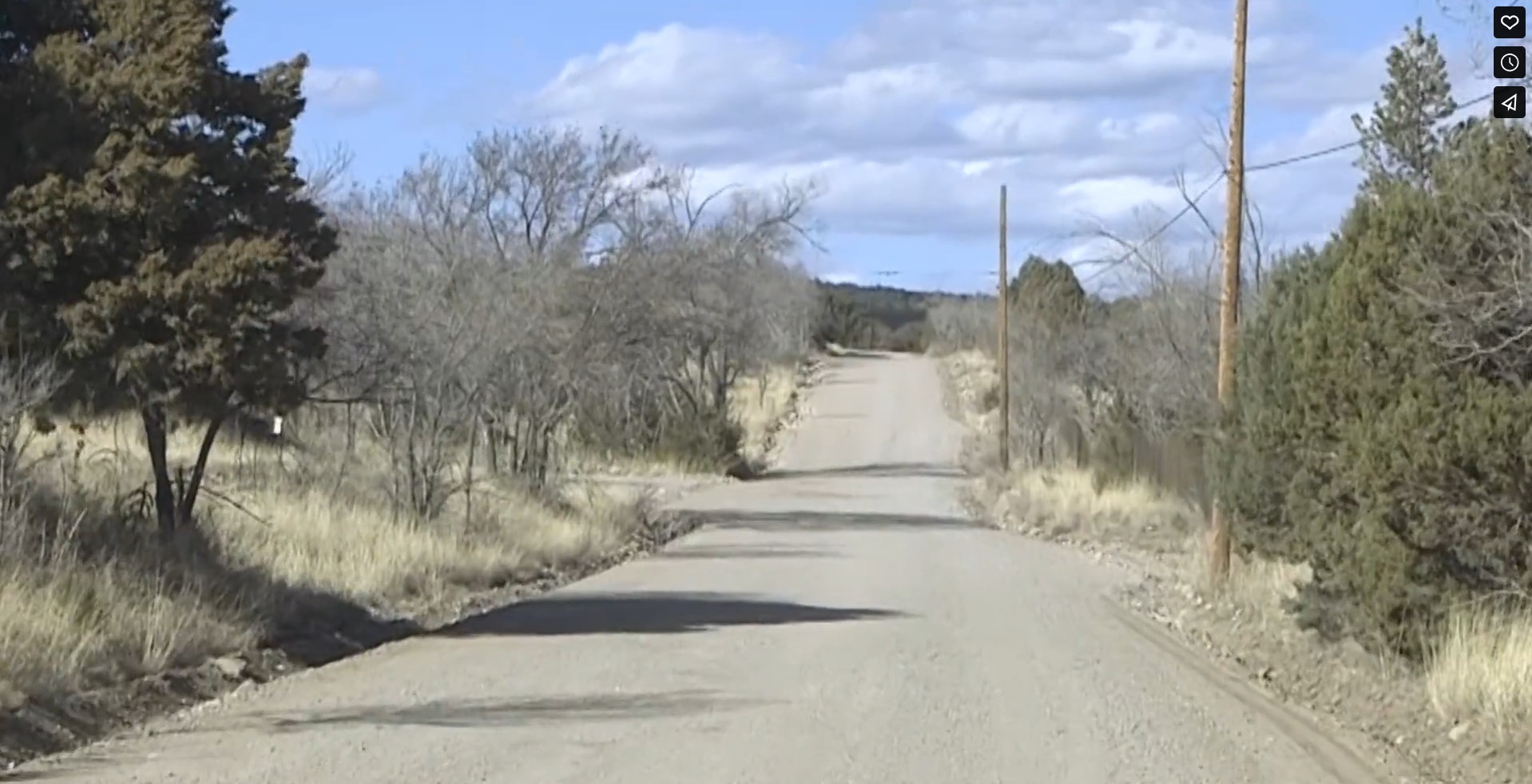 |
"There's a cemetery over here." "I'm going to ask you more about this later. What happened to your dad's house?" "It was the mine. It was part of Santa Rita." |
This is an interview with my community liaison, Frances Gonzales, who is not featured in this film. | I felt the need to include footage of what the area looks like now. While I never left the house with Olga, I went on several car rides around the area with Frances. She was not committed to doing an interview, but she allowed me to film several tours around the area. Her local knowledge of the area helped me sense the layout of the town. I knew viewers might better understand the devastation of the participants from seeing how empty the area is now. |
| 7:29 | 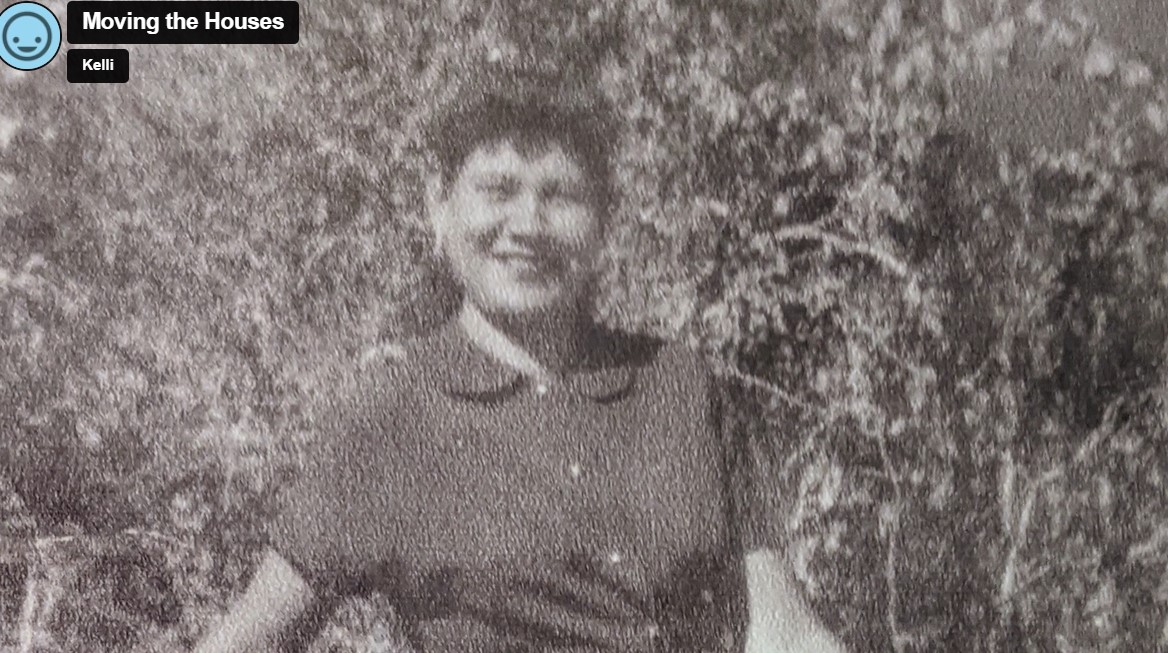 |
"They finally went up to her and said—Salce was Olga's maiden name. They said, 'Mrs. Salce, we have let you live here a year longer than you're supposed to.'" | This image is actually a photograph of Olga's grandmother not her mother. | When making the short documentary, I mistakenly thought this was an image of her mother and had to look back at my notes to realize that it was her Grandmother. I felt like Olga's mother's story was very poignant, but audiences might better connect with her if she had a face. |
| 8:21 | 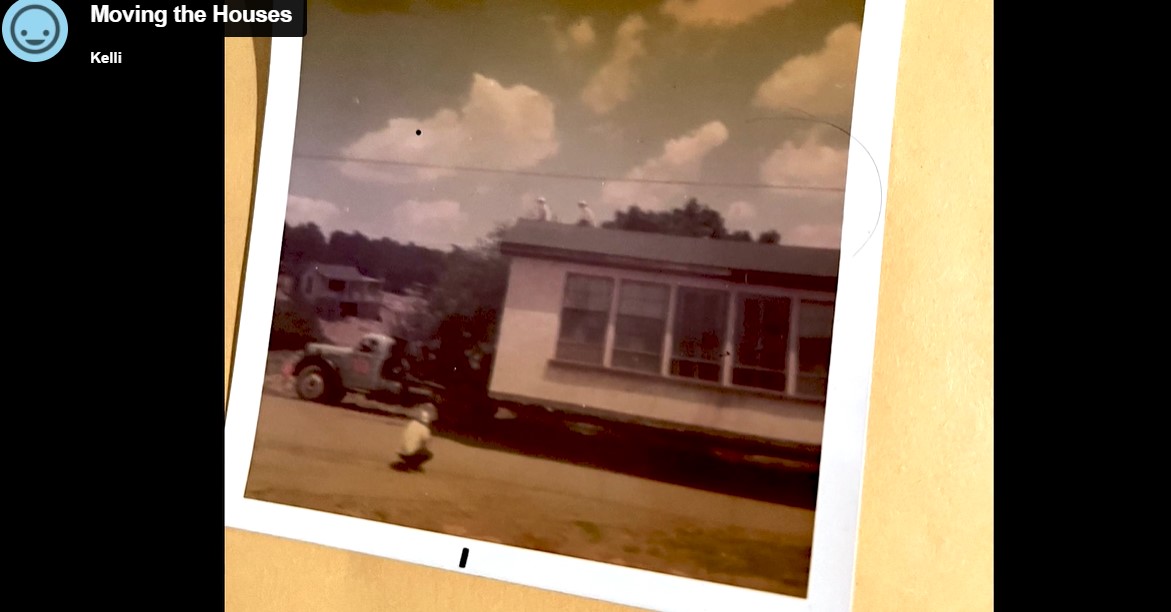 |
"But anyway, the Anglo side got moved first because they were the closest to the mine. And then they started doing away with all of our little barrios." | This is an image of the Delgado Brothers moving the Santa Rita Catholic school. It is not actually a house being moved in the photograph. | Nearly all the participants talked about the moving of the houses. They noted how impressive it was to be able to pick up whole buildings, and how the Delgado Brothers invented this method of picking them up. However, I was only able to secure two photos. When looking at this photo, you cannot tell that it's not a house unless you are familiar with the school. I included the image to help the imagination of the viewer. I also wanted to break up the interview from the large chunk of interview footage. |
| 12:29 | 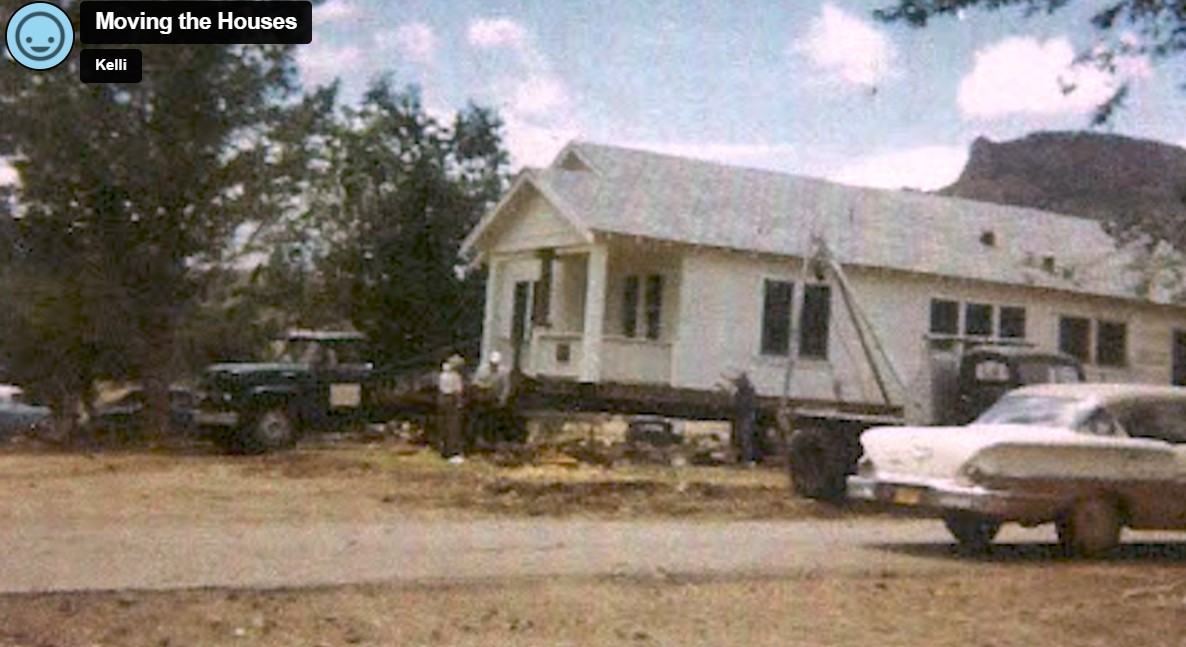 |
"And I remember, we rode behind it part of the way." | This is a photo of the moving of the Bush residence from the Ball Park area of Santa Rita in June 1966. It is not MaryAnn's house, but House No. 1154, which was moved to Bayard. | Terry emailed me this photo, and it was the clearest image I had of the moving of the houses. I knew the participants would want to see the photo, especially with the Kneeling Nun as a landmark in the background. |
This index details the tricky edits I made as the producer of one of the documentary films. These appendices that follow each documentary chapter make my editing decisions transparent in an effort to pursue historical accuracy.
As a documentary editor, I acknowledge that it is sometimes in my best interest to withhold information from viewers. Documentary relies heavily on narrative to carry the genre forward. This can be done to create suspense, to build drama, or to simply keep the audience guessing. As Jacob Bricca (2023) stated, "[by] focusing meaning—highlighting certain material, excluding other material, and rearranging it in order to produce a story—documentary launches into the realm of the semifictional because the logic of stories is not necessarily the logic of real life" (p. 56). As a scholar, I am acutely aware of the responsibilities that come with crafting the narrative arc of a documentary, including the ethical considerations of what information is withheld or how it is presented. My commitment to not misleading or deceiving my audience has led me to document my editing decisions comprehensively. The aim of documentary methodology in rhetoric and composition is to infuse feminist values into the editing process, ensuring that the filmmaker's approach is characterized by ethical mindfulness and collaboration. This involves grounding the documentary, and the broader project, in principles of dialogue, transparency, and care.
In my own editing decisions, I aimed to enhance the narratives that align with the participants' stories. The following lists denote how the dual genres of academic dissertations and documentary films influenced my process for writing the Into Space: Film-book.
Conventions of the Film-book which are Influenced by Academic Writing
- Comprehensive methodology section that includes a methodological framework and key decisions about how the data was coded
- Explanation of the research questions and findings
- Appendix of the full interviews
- Appendix of the editing decisions made in the interest of transparency
- Reflection on my experiences as a researcher throughout this process
- Sourced material cited in the credit roll, including interviews, archival footage, photos, and archival written material
Conventions of the Film-book which are Influenced by Documentary Production
- Refined narrative with a dramatic arc in each film chapter
- Characters are drafted from the footage of the real participants in order to serve a story
- Delayed gratification "in order to deliver a continually satisfying narrative experience" (Bricca, 2023, p. 56)
- Actors enlisted to re-enact written archival work
- Integration of a musical score
- Collaborator contributions cited in the credit roll, including archivists, camera assistants, musicians, actors, community liaisons, and fact-checkers
Building a Methodological Bridge
Aside from a difference in content and genre features, the process of producing and editing a documentary film also varies from that of an academic book. As noted above, Bill Nichols (2001) defined documentaries as "representations of reality." He argued that we should judge documentaries not by their fidelity to the truth, but by the pleasure they offer, the insights they provide, and the perspectives they convey. They are not usually thesis-driven, and the author's voice is often hidden. Instead, documentaries rely on tension, drama, and character development to create a compelling narrative. In How Documentaries Work, Jacob Bricca (2023) described the process of creating a narrative in a documentary as "building causality and attaching meaning to heretofore inert facts—highlighting certain material, excluding other material, and rearranging it in order to produce a story" (p. 56). Thus, it is important to acknowledge that in creating documentaries, I am always curating the way a viewer experiences the memory of Santa Rita even when it might not be apparent. Though I receive the memories of Santa Rita as discrete narratives, I usher them into familiar structures by utilizing common narrative techniques such as exposition, rising action, conflicts, and resolution, thus shaping the story in a way that does not resemble the objective findings of a qualitative research project. I mark this distinction between academic writing and documentary production to acknowledge how my biases and filmmaking decisions influence the narrative, even though the participants' voices are not my own.
I want to emphasize that choosing which methods to use in this project was not always straight-forward and required flexibility, listening, and reflection. In the lists below, I detail how I culled methods from both academic social science research and documentary production.
Methodological Process Derived from Social Science Research
- Research questions lead decisions on how to collect and analyze data
- Interview questions refined with each of the participants
- The coding process determined by interview questions and refined after each participant
Methodological Process Derived from Documentary Production
- Media—interview footage, archival stills, etc.—must be organized into digital folders in a nonlinear editing platform
- Editing process begins with reels that lack structure (antithetical) at first and are refined into "rough cuts" through drafting and feedback
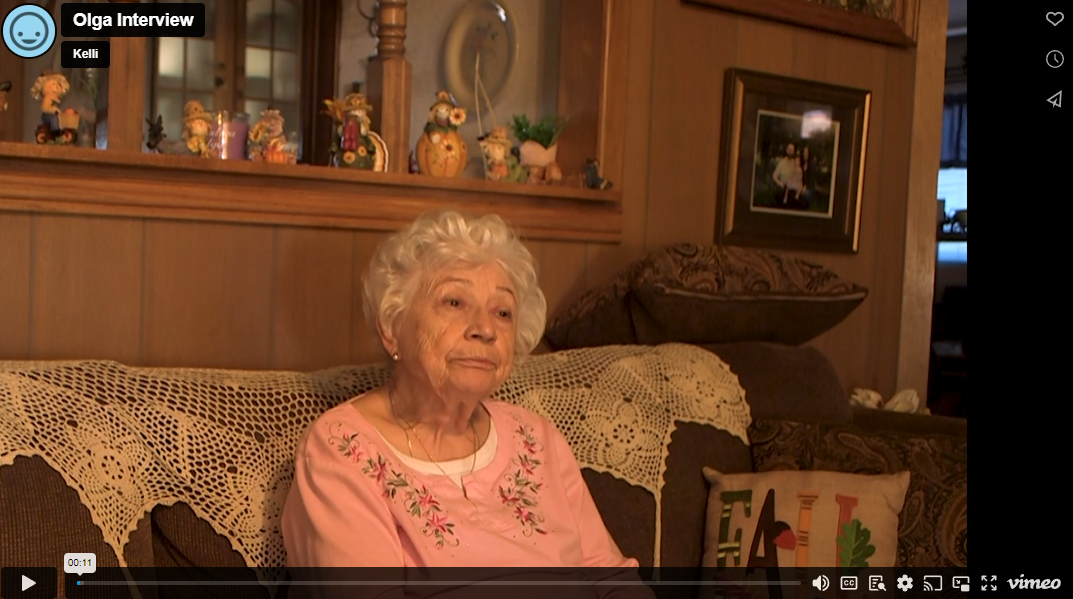
One of the ways I embraced hybrid methods was by inviting participants to choose the location for their oral history, integrating their agency into the research process. A majority of participants chose to conduct the interview in their homes for their convenience. Consequently, filming the oral histories in their homes allows viewers to take note of the participants' material contexts, as I illustrate in the two images below. The items in the frame for each interview help develop the characterization of each participant, leaving an impression on the audience (Bricca, 2023, p. 33).
Consider these two images of the participants interviewing in their homes. In Figure 3, my participant Olga was sitting on her couch which is draped with a crochet throw that she made and a pillow that read "FALL," demonstrating how Olga decorates her house for the holidays. Ceramic pumpkins, sunflowers, and scarecrows line the windowsill behind her head. She had a picture of her son and his family on the wall behind her. These visual details not only tell us about Olga's interests and values but also demonstrate the material objects she surrounds herself with. In our time together, Olga told me that her husband, Archie, had recently passed away. Since his passing, she hadn't felt like herself, and her children were concerned that she didn't want to decorate for Halloween. She told me her son put up the few fall decorations you see in the frame. This is one example of how the objects that surround the participants symbolize identity in flux.
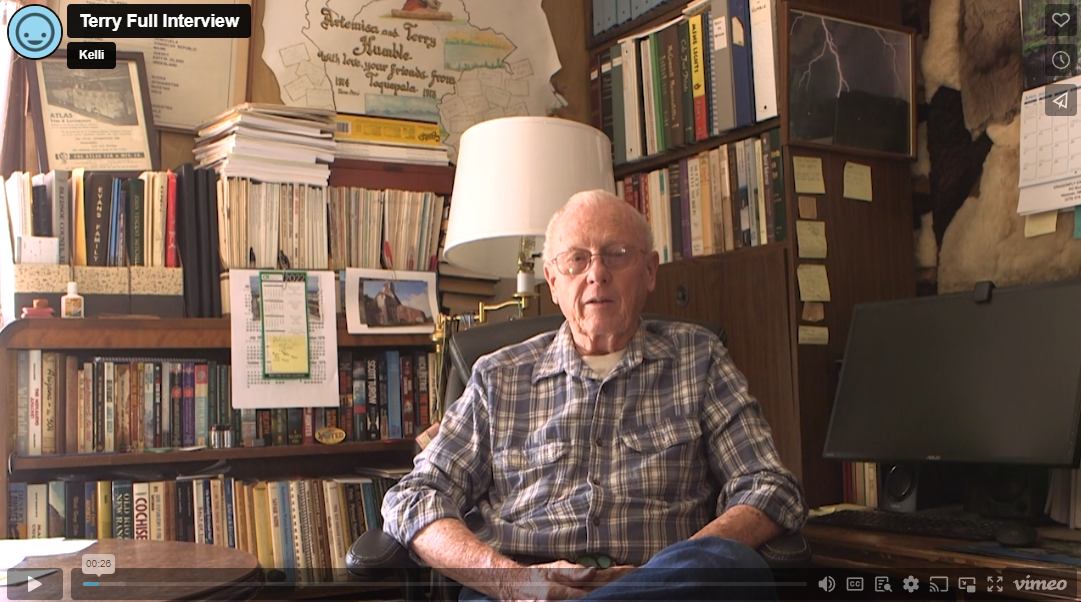
In contrast to Olga, Figure 4 shows Terry seated in his library with shelves of books and magazines behind him that affirm his appointed title as the town historian. He had skins of an alpaca on the wall to the left of him, and a homemade sign from his former colleagues when he lived and worked in Peru. By showing my participants in their homes, I presented them in their daily material contexts.
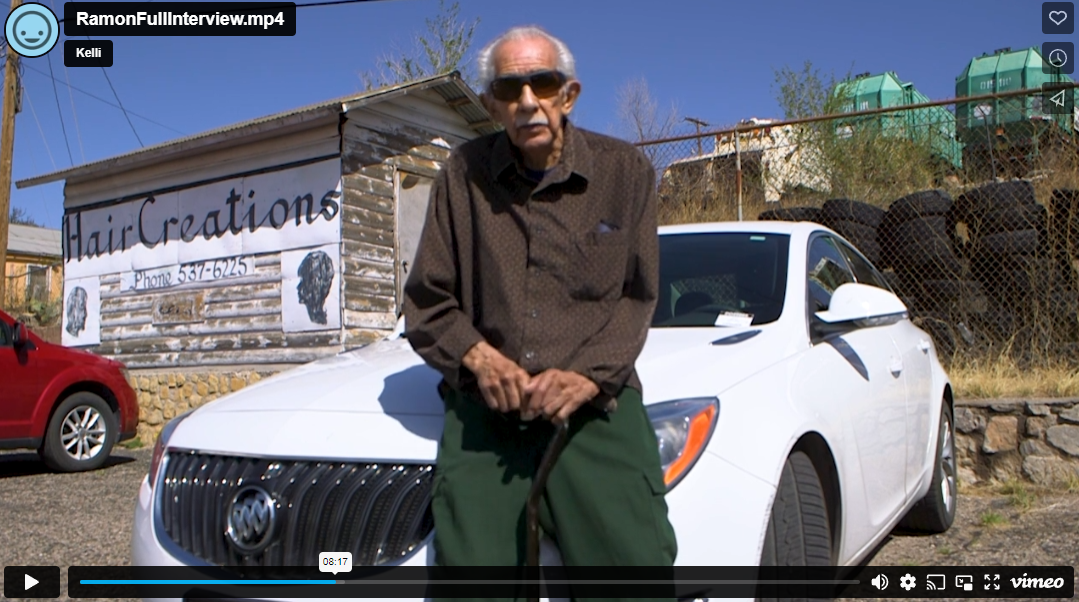
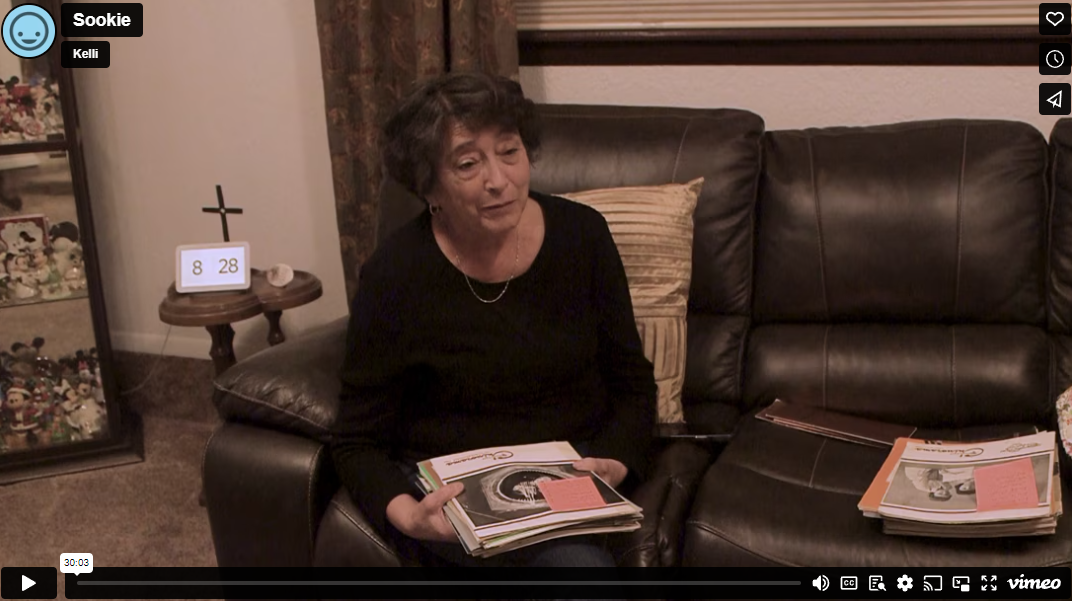
Shooting the interviews in the location of their choice was not always to my advantage. In fact, doing so goes against the advice to shoot interviews with similar backgrounds, as suggested by Bricca (2023) who said, "If all interviews carry visual commonalities by shooting them under similar conditions in a studio, this tamps down the sense of chaos and arbitrariness that can quickly overwhelm the visual universe of a documentary" (p. 29). By allowing the interviewees to choose where they interview, I not only invite a "sense" of chaos; I also increase literal chaos. Consider how the image of Ramon below, in Figure 5, contrasted with the image of Sookie in Figure 6 sitting in her living room. There are clear visual disparities between the parking lot of a beauty shop under the harsh contrast of the glaring sun and a tidy, well-decorated living room in the evening. Since I met Ramon at the beauty shop, I also lost control of the interview space.
The alignment of goals between rhetorical memory scholarship and documentary work isn't always seamless. To address this disparity, my decision to film interviews in participant-selected locations aimed to dismantle entry barriers for interviewees while fostering a sense of comfort during their conversations. As noted above, the physical space of interaction creates visual and auditory experiences for the audience. Elements like visual cues, the surrounding environment, and even ambient sounds like traffic and television collectively contribute to enhancing perception and forging connections between interviewees, interviewers, and viewers, even when there are issues with sound and lighting. In considering the primary audience, the Santa Rita community, the familiarity of seeing fellow community members within their habitual settings could also resonate with their own memories. This is one example of how my feminist rhetorical research methods were sometimes in conflict with those of documentary film production. The project inherently navigates a delicate balance between film quality and research integrity, urging me to refine these competencies and experimental processes that consider both scholarly practices and production standards.
I adjusted my interviewing questions and techniques to create narrative-driven documentaries. Based on techniques I learned from my documentary production classes, all interviews began by asking participants to state their full name, however they would like to be known in the film, in a complete sentence. As a practice, this allowed me to introduce each participant as a developing character in the films (e.g., "My name is Olga Chavez"). I coached interview participants before beginning the interview to inform them about the awkward pauses in communication that they would experience during the interview—much longer than what happens in a typical conversation. The quiet times in between questions and their answers were beneficial for film editing. Leaving this pause also allows a filmmaker to film some of their emotional reactions or body language in their responses. Some participants were more comfortable with this pause than others. My participant, Esther, for example, would try to fill the space anyway. "Okay," she said, "next question?" For other participants, this technique allowed me to film intimate moments of reflection. One such moment occurred at the end of my interview with a participant, Cuca. After a brief silence, she began to cry. Her gaze shifted from looking at the camera to looking at me: "So it's fascinating. I get emotional about this," she said, as tears rolled down her face.
As I began interviewing participants, I realized how creating a film changed the kind of information I would need to develop a narrative. As an example, I needed footage of an interview participant explaining what happened to the town and why it was evacuated. I began adding questions I knew I would need for the story. My later participants answered the questions, "If someone had never heard of Santa Rita, how would you describe it?" and "What happened to the town?" In this way, the genre of documentary changed the questions that I began asking and made the interview process slightly less systematic than a traditional qualitative research study. However, it allowed me to be more flexible with the interview process which proved beneficial for building relationships with the participants.
Each participant's interview had its strengths and focuses. Some interview participants were eager to tell stories and had a particular angle they wanted to focus on. My participant, Richard, for example, wanted to talk about the Empire Zinc mine strikes that took place in the area in the early 1950s and the importance of the local mining union, the Mine-Mill and Smelter Worker's Union, Local 890. Sookie was eager to talk about a generational shift in values and what cultural practices from Santa Rita she hopes to pass on to her children. Other interviewees such as Cuca and Larry stuck close to the questions I asked. Regardless, each interview seemed to offer a theme as demonstrated below in Figure 7.
| Name | Years in Santa Rita | Age when They Left Santa Rita | Neighborhood | Emerging Themes |
|---|---|---|---|---|
| Olga | 1941–1961 | 20 | Georgetown Rd, House #1398, PO Box #614 | inequality, religious ceremonies, Catholicism |
| Sookie | 1948–1967 | 19 | Las Casas Nuevas | generational shift, crowdsourcing resources, Santa Rita houses |
| Terry | 18 | Iron Hill | saved objects, Santa Rita houses | |
| Ramon | 1942–1963 | 21 | Mexican Town | inequality, racism |
| Richard | 1950–1962 | 12 | New Houses, Georgetown Rd. | the union, Salt of the Earth (film), military affiliations |
| MaryAnn | 1957–1967 | 10 | Under the Kneeling Nun | The Kneeling Nun, nicknames, Santa Rita houses |
| Cuca | 1943–1959 | 16 | House #1123, PO box #518 | town amenities, generational shift |
| Johnny | 1942–1970 | 28 | Near the Catholic Church, Georgetown Rd. | Santa Rita Shrine, Society of Persons Born in Space, Community Church |
| Esther | 1950–1966 | 16 | The Canyon | gender differences, the union, generational shifts |
| Larry | –1967 | 14 or 15 | Las Buncas, Santa Rita Hill | company control |
A table of the participants' years in Santa Rita, their age when they left, their geographical location or neighborhood in Santa Rita, and the themes highlighted in each of their narratives.
I converted the interviews into transcripts and coded them using Atlas.ti. One such theme that emerged early in the coding process was "military affiliation" as I originally coded in Olga's interview. She discussed the shift in Grant County when "the boys" came home. She told me that "the boys" were no longer willing to cope with discrimination. Confused about who "the boys" were and where they came home from, I began looking back at the archival material I had collected to answer these questions. Through reiterative coding, and by asking questions of my participants outside of interviews, I learned that "the boys" were those who served in World War II. Grant County, New Mexico, suffered the greatest number of lives lost during World War II—more than any other county in the United States, according to participants. As I attended the rededication ceremony of the Bataan Memorial Park in Santa Clara, New Mexico, I learned that, "out of the 1,816 New Mexico National Guardsmen sent to defend the Philippines, 829 never returned home" (McDonough, 2021, citing New Mexico U.S. Senator Ben Ray Luján). It makes sense that such a great loss would weigh heavy on the memory of the community and spark a change in attitudes about discrimination, and that this event changed the memory of Santa Rita, New Mexico forever. My intention was to develop each of the stories that emerged from the coding into documentary film chapters for Into Space: Film-book.
I tell this story about one of the many themes that emerged because stories and storytelling were central to my methodological process. As Emily Legg and Patricia Sullivan (2018) explained in "Storytelling as a Balancing Practice in the Study of Posthuman Praxis," feminist researchers often use stories as a method of data collection, but storytelling itself is often lost in the methods of the research. As stories become coded, they are turned into data, such that individual threads of the story are often lost. When I began this project, I did not imagine that the military history of the area would play such a role in my findings. However, early and recursive coding allowed me to follow themes as they emerged. I believe that when you honor the individual stories, you honor the participants' own memory-making. One of the goals of using documentary filmmaking as a rhetorical feminist practice is to honor the individual threads of storytelling.
I want to end this webtext with a disclaimer that I am not a filmmaker by profession. Before working with Into Space: Film-book, I had never produced films of any length or repertoire. I had taken courses on documentary film production and documentary history. However, I find great wealth in exploring the ways in which different fields can enhance and contribute to one another. I was struck by the ways in which producing films helped me reflect on my feminist research practices. I have since made efforts to research and understand the overlaps between documentary filmmaking and rhetoric and composition. And I am inspired by what I have learned. I am eager to bring some of that knowledge to my home discipline of rhetoric and composition. In writing this, I pick up the metaphorical torch that Alexandra Hidalgo is handing off to other scholars in the field. She said, "We want to show the richness that can occur when those who are different come together, and documentary filmmaking is an ideal medium for doing just that" (2017, 18:28). I see this video essay as my call to action to pick up the camera, especially as my research acknowledges race, age, gender, and class as factors in collective memory. I further acknowledge how documentary filmmaking as a methodology aligns with feminist rhetorical practices, providing a powerful tool for collaborative community-engaged research that enriches our understanding of the complex relationships between identity, place, and community.
Works Cited
Arteaga, Rachel. (2020, January 03). Reflections on the humanities PhD: Innovative dissertations and adaptable careers. Simpson Center for the Humanities. https://simpsoncenter.medium.com/humanities-research-at-the-leading-edge-of-change-d545ea3ba51
Barnett, Scot, & Boyle, Casey. (2016). Rhetoric, through everyday things. University of Alabama Press.
Bentley, Elizabeth, & Lee, Jamie A., with FARR. (2018). Performing the archival body: Inciting queered feminist (dis)locational rhetorics through place-based pedagogies. Peitho, 21(1), 183–211.
Blair, Carole. (1999). Contemporary U.S. memorial sites as exemplars of rhetoric's materiality. In Jack Selzer & Sharon Crowley (Eds.), Rhetorical bodies (pp. 16–28). University of Wisconsin Press.
Bodnar, J. (1992). Remaking America: Public memory, commemoration, and patriotism in the twentieth century. Princeton University Press.
Bricca, Jacob. (2018). Documentary editing: Principles & practice. Routledge.
Bricca, Jacob. (2023). How documentaries work. Oxford University Press.
Butler, Janine. (2016). Where access meets multimodality: The case of ASL music videos. Kairos: Rhetoric, Technology, and Pedagogy, 21(1). https://kairos.technorhetoric.net/21.1/topoi/butler/index.html
The Chicana por mi Raza Digital Memory Project. (n.d.). Chicana por mi Raza. Retrieved September 28, 2023, from https://chicanapormiraza.org/
Cotera, María. (2018). Nuestra autohistoria: Toward a Chicana digital praxis. American Quarterly, 70(3), 483–504. https://doi.org/10.1353/aq.2018.0032
Crenshaw, Kimberlé. (2016, October). The urgency of intersectionality. TEDWomen. https://www.ted.com/talks/kimberle_crenshaw_the_urgency_of_intersectionality
Dickinson, Greg, Blair, Carole, & Ott, Brian L. (2010). Places of public memory: The rhetoric of museums and memorials. University of Alabama Press.
Gonzales, Laura. (2017). Using ELAN video coding software to visualize the rhetorics of translation. Kairos: Rhetoric, Technology, and Pedagogy, 21(2). https://praxis.technorhetoric.net/tiki-index.php?page=PraxisWiki%3A_%3AELAN
Gronbeck, Bruce E. (1998). The rhetorics of the past: History, argument, and collective memory. In Kathleen J. Turner (Ed.), Doing rhetorical history: Concepts and cases (pp. 47–60). University of Alabama Press.
Halbwachs, Maurice. (1942). On collective memory (Francis J. Ditter & Vida Yazdi Ditter, Trans.). University of Chicago Press.
Hidalgo, Alexandra. (2016, April 20). Vanishing fronteras: A call for documentary filmmaking in cultural rhetorics (con la ayuda de Anzaldúa). Enculturation: A Journal of Rhetoric, Writing, and Culture. http://www.enculturation.net/vanishing-fronteras
Hidalgo, Alexandra. (2017). Cámara retórica: A feminist filmmaking methodology for rhetoric and composition. Computers and Composition Digital Press. https://ccdigitalpress.org/book/camara/intro.html
Hodgson, Justin. (2016). Reculturalizations: 'Small screen' culture, pedagogy, & YouTube. Enculturation: A Journal of Rhetoric, Writing, and Culture, 21(1). https://enculturation.net/reculturalizations
Lane, Penny. (n.d.). Notes on nuts. http://notes.nutsthefilm.com/
Lee, Jaimie. (2019). In critical condition: (Un)becoming bodies in archival acts of truth telling. Archivaria: The Journal of the Association of Canadian Archivists, 88, 162–195. https://archivaria.ca/index.php/archivaria/article/view/13703
Lee, Jaimie. (2021). Producing the archival body. Routledge.
Legg, Emily, & Sullivan, Patricia. (2018). Storytelling as a balancing practice in the study of posthuman praxis. In Kristen R. Moore & Daniel P. Richards (Eds.), Posthuman praxis in technical communication (pp. 25–45). Routledge. https://doi.org/10.4324/9781351203074
McDonough, Richard. (2021, July 4). New Mexico and Bataan. The Grant County Beat. https://web.archive.org/web/20211202065505/https://www.grantcountybeat.com/columns/informational/the-chronicles-of-grant-county/65989-new-mexico-and-bataan
Moraga, Cherríe, & Anzaldúa, Gloria. (2021). This bridge called my back: Writings by radical women of color (40th anniversary ed.). SUNY Press.
Nichols, Bill. (2001). Introduction to documentary. Indiana University Press.
Nora, Pierre. (1996). Realms of memory: The construction of the French past: Vol. 1, Conflicts and divisions (Arthur Goldhammer, Trans.). Columbia University Press.
Postman, Neil. (2005). Amusing ourselves to death: Public discourse in the age of show business. Penguin Books.
Rose, Emma, & Cardinal, Alison. (2018). Participatory video methods in UX: Sharing power with users to gain insights into everyday life. Communication Design Quarterly, 6(2). https://doi.org/10.1145/3282665.3282667
Shivers-McNair, Ann. (2017). 3D interviewing with researcher POV video: Bodies and knowledge in the making. Kairos: Rhetoric, Technology, and Pedagogy, 21(2). https://praxis.technorhetoric.net/tiki-index.php?page=PraxisWiki:_:3D%20Interviewing
Royster, Jacqueline Jones, & Kirsch, Gesa E. (2012). Feminist rhetorical practices: New horizons for rhetoric, composition, and literacy studies. Southern Illinois University Press.
Vivian, Bradford. (2018). Memory: Ars memoriae, collective memory, and the fortunes of rhetoric. Rhetoric Society Quarterly, 48(3), 287–296. https://doi.org/10.1080/02773945.2018.1454214
Wall Kimmerer, Robin. (2015). Braiding sweetgrass: Indigenous wisdom, scientific knowledge and the teachings of plants. Milkweed Editions.
Weiser, M. Elizabeth. (2017). Museum rhetorics: Building civic identity in national spaces. Pennsylvania State University Press.